
PRESIDENT: Nasry Asfura (Jan. 2026 - 2030)
POPULATION: 9.5 million
KEY EXPORTS: coffee, shrimp, bananas, tobacco
PRESIDENT: Nasry Asfura (Jan. 2026 - 2030)
POPULATION: 9.5 million
KEY EXPORTS: coffee, shrimp, bananas, tobacco

Home page >> Latin America Intro page >> Honduras ("under reconstruction")Updated:
| Decade / year | Key events |
| 1820s | Independence from Spain in 1821. |
| 1830s | Secession from Central American Confederation in 1839. |
| 1840s | . |
| 1850s | . |
| 1860s | . |
| 1870s | . |
| 1880s | . |
| 1890s | . |
| 1900s | . |
| 1910s | . |
| 1920s | . |
| 1930s | . |
| 1940s | . |
| 1950s | U.S.-backed military coup ousts leftist government. |
| 1960s | Political turmoil & repression. |
| 1970s | Political turmoil & repression. |
| 1980s | . |
| 1990s | . |
| 2000 | . |
| 2001 | . |
| Jan. 2002 | Soon after Ricardo Maduro is inaugurated president, it is learned that there was a plot by "Los Benedictos" gang to assassinate him. |
| Sept. 2002 | El Salvador announced it would appeal the 1992 World Court ruling on the border with Honduras. It seeks 70.6 square kilometers of land in the Goascoran River valley, as well as the island of Conejo. |
| Jan. 2003 | Pres. Maduro established special police and prosecutor units to combat gang-related killings. Many Honduran emigrants joined gangs in L.A., then returned home. |
| Apr. 2003 | An uprising at Porvenir prison (near the Caribbean Sea) killed 69 people, mostly gang members, and wounded 31. |
| May 2004 | Fire in an overcrowded prison in San Pedro Sula kills 103 prisoners. 1,960 inmates, vs. 800 capacity. Guards shot at inmates trying to escape flames. |
| Dec. 2004 | Gang members with assault rifles seized a bus in San Pedro Sula, robbing and killing 28 passengers just before Christmas. They left note saying they were revolutionaries against the proposed death penalty. |
| Nov. 2005 | Manuel Zelaya, a Liberal, defeats "Pepe" Lobo Sosa in a very close presidential race. The results were disputed, and the winner was not certified until December. |
| Jan. 2006 | Manuel Zelaya is inaugurated president. He pledges to support small businesses and move forward with CAFTA. |
| Mar. 2007 | The World Court opens hearings on an old dispute between Nicaragua and Honduras, who have conflicting territorial claims over a few small islands and coral reefs in the Caribbean Sea. |
| June 2009 | At request of Congress and Supreme Court, military removes President Zelaya, who is forced into exile. He appeals to U.N. for help. |
| Sept. 2009 | Zelaya returns from exile, takes refuge in Brazilian embassy. |
| Dec. 2009 | Porfirio "Pepe" Lobo was elected with 56% of vote, despite calls for boycott by Manuel Zelaya. |
| 2006 | |
| 2007 | |
| 2008 | |
| 2009 | |
| 2010 | |
| 2011 | |
| 2012 | . |
| 2013 | |
| 2014 | |
| 2015 | |
| 2016 | |
| 2017 | . |
| 2018 | . |
| 2019 | |
| 2020 | |
| 2021 | |
| 2022 | |
| 2023 | |
| 2024 | . |
| 2025 | . |
| 2026 |
SOURCE: Washington Post, CNN, etc.

Most of Honduras is hilly or mountainous terrain. Most of the people live in small towns or rural areas, and there are only two large cities: Tegucigalpa, the capital, in the southern highlands, and San Pedro Sula, the center of industry of commerce, in the northwest. In the eastern corner is the vast swamp of the Mosquito Coast, which extends into Nicaragua.
NEIGHBORS: Guatemala, El Salvador, and Nicaragua
Honduras gained independence as a separate country when the Central American Confederation fell apart in 1838. Like most of its neighbors, it was unstable for many decades thereafter, with many golpes de estado (coups). Foreign investment in banana plantations late in the 18th Century launched an economic modernization, but it was not of a self-sustaining nature. As in most other countries in the region, the unemployment caused by the Great Depression led to social turmoil, setting the stage for a coup. The dictator Tiburcio Carís Andino held on to power for an unusually long period, 1932-1949, cooperating with the United Fruit Company in keeping labor unions under control. Even after he left, the National Party remained dominant, supported by banana exporters. A military coup in 1956 led to a new constitution and a big electoral victory by the Liberal Party, which enacted various modernizing reforms. (Unlike its neighbor, Guatemala, the armed forces sided with reformists during this period.) The military felt threatened by the creation of a politicized Civil Guard, however, and overthrew the government in 1963. General Oswaldo Lopez Arellano ruled the country for the next 12 years, forming an alliance with the National Party. In 1969 Honduras was invaded by El Salvador in the "Soccer War," named for a soccer match that precipitated overt hostilities. The underlying tensions stemmed from the illegal immigration of people from El Salvador, which was becoming overcrowded. El Salvador was pressured by the OAS to withdraw its forces after several days of fighting. General Arellano resigned in 1975 after the bribes he was taking from United Fruit were exposed. During the 1980s Honduras served as a tacit ally of the United States in the covert war against the Sandinista government of Nicaragua. In 1982 the generals handed power over to civilians, under pressure from the Reagan administration. The CIA trained a special unit ("Battalion 316") that was later accused of kidnappings and murders, and thousands of U.S. troops were deployed there in 1988 on a "training mission" to deter further border incursions. This military presence prompted an upsurge in anti-U.S. sentiment, ironically exacerbated when U.S. troops left abruptly after the Sandinistas lost the election in 1990, and the U.S. embassy suffered damage in riots during the 1990s. With no further need of a strategic ally in the region after the Cold War ended, the U.S. government began pressuring Honduran military forces over human rights violations, which caused resentment. Nearly 6,000 Hondurans lost their lives in flooding caused by Hurricane Mitch in 1998.
Nearly all Honduran people are mestizos, except for the Caribbean coast where there is a small minority of African-descended people whose ancestors were slaves. There is a major archeological site at Copan in the north, but there is little evidence of the Mayan culture in the Honduran society of today. Unlike Guatemala, there are hardly any communities where Indian languages are spoken.
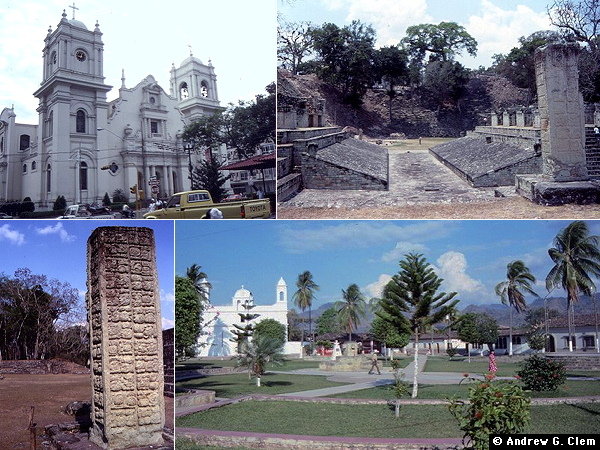
CLOCKWISE FROM TOP LEFT: Church in San Pedro Sula; Ballcourt at the ruins of Copan; Plaza in the town of Santa Rosa de Copan; Engraved stellae (ancient monument) at Copan.
(Photos taken in 1989. To see these and other photos on the Honduras photo gallery page, click on the adjacent image.)
The relative lack of repression in Honduras may stem from the socio-economic structure. Unlike Guatemala, there was no coffee-growing oligarchy. The landowning elite had more diverse interests, and the agricultural base was therefore more diverse, helping to stabilize the economy as well as the political system. Even though the government has been run by elected civilian officials since 1982, the military has remained very powerful behind the scenes. (This was demonstrated by the militay coup in June 2009.) In 1996 President Carlos Reina forced the military to accept a cutback in strength and a reduced budget. The relative lack of class conflict, the political parties are less ideological than elsewhere in Latin America, lacking a clear policy agenda. They are basically patronage machines, in which people expect to get jobs in exchange for political support. This means that there is relatively little responsiveness of government policy to popular pressure. One pathological symptom of the absence of institutions of civil society in Honduras is the rise of street gangs, which have led to a major increase in robbery and murder. Roberto Micheletti was de facto president from June 2009 until 2010.
SOURCE: CIA World Factbook (defunct) .
Proceso (Tegulcigalpa)
El Heraldo (Tegulcigalpa)
La Prensa (San Pedro Sula)
