
PRESIDENT: Santiago Peña (Aug. 2023 - 2028)
POPULATION: 7.5 million
KEY EXPORTS: Contraband
PRESIDENT: Santiago Peña (Aug. 2023 - 2028)
POPULATION: 7.5 million
KEY EXPORTS: Contraband

Home page >> Latin America Intro page >> Paraguay ("under reconstruction")Updated:
| Decade / year | Key events. |
|---|---|
| 1800s (early): | Independence from Spain was declared in 1811. |
| 1800s (mid): | Defeat in War of the Triple Alliance (1865-1870) vs. Brazil, Argentina, & Uruguay, huge population loss. |
| 1800s (late): | . |
| 1900s | |
| 1910s | . |
| 1920s | . |
| 1930s | Victory over Bolivia in the Chaco War (1932-1935), gain of territory. |
| 1940s | . |
| 1950s | Alfredo Stroessner becomes dictator in 1954. |
| 1960s | . |
| 1970s | . |
| 1980s | Stroessner is ousted by a military coup in 1989. |
| 1990s | Transition to democracy. |
| Mar. 1999 | Eight protesting students were killed by police. Senate leader Luis Gonzalez Macchi became president after Raul Cubas resigned, implicated in the assassination of V.P. Luis Maria Argaña. |
| May 2000 | Foiled coup attempt, blamed on exiled General Oviedo. |
| July 2002 | State of emergency due to violent protests against austerity; rumors of a military coup. |
| Dec. 2002 | Chamber of Deputies voted 50 to 0 (11 abstained) to impeach Pres. Gonzalez Macchi, on five counts of corruption. |
| Feb. 2003 | Senate failed to remove Pres. Gonzalez Macchi from office. Rumors of a coup plot. Paraguay defaults on debt. |
| Apr. 2003 | Nicanor Duarte (Colorado Party) won presidential elections. Catholic bishops and opposition groups charged electoral fraud. |
| Aug. 2003 | Nicanor Duarte, age 47, was inaugurated as president, vowing an all out war on the "mafias" and corruption. |
| Apr. 2004 | Peasants begin land invasions, demanding redistribution of agricultural land. |
| June 2004 | Gen. Oviedo returned to Paraguay from exile in Brazil and was imprisoned for plotting 1996 coup. |
| Aug. 2004 | Over 400 are killed in a fire in a large supermarket on the outskirts of Asuncion; caused by gas explosion. |
| Feb. 2005 | Daughter of ex-Pres. Cubas is kidnapped and murdered. Pres. Duarte vows to crack down on organized crime. |
| June 2005 | Proposed privatization of public utilities is defeated in Congress. |
| Aug. 2005 | Sec. Def. Rumsfeld visited Paraguay; small anti-U.S. protest. U.S. Special Forces joint exercises, until end of 2006. Paraguay hosts the first-ever conference of landlocked nations; over 30 take part. |
| Apr. 2006 | Paraguay hosts a summit of Latin American leaders, at which President Hugo Chavez declared that Venezuela will withdraw from the Andean Community of Nations. |
| June 2006 | Former President Luis Gonzalez Macchi was sentenced to six years in prison on embezzlement charges. |
| Aug. 2006 | Alfredo Stroessner, who ruled Paraguay from 1954 until he was overthrown in 1989, passed away in Brazil. He spent the last 17 years of his life in exile. |
| Apr. 2008 | Former priest Fernando Lugo (Patriotic Alliance for Change," a center-left coalition) defeats Blanca Ovelar (Colorado Party), 41%-30%. |
| Aug. 2008 | In anticipation of inauguration, landless peasants staged invasions of an hacienda in the north. |
| 2009 | |
| 2010 | |
| 2011 | |
| 2012 | . |
| 2013 | |
| 2014 | . |
| 2015 | |
| 2016 | |
| 2017 | . |
| 2018 | . |
| 2019 | . |
| 2020 | |
| 2021 | |
| 2022 | |
| 2023 | |
| 2024 | . |
| 2025 | . |
| 2026 |
SOURCES: Washington Post, CNN, BBC, etc.
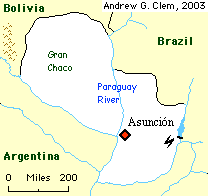
Along with Bolivia, Paraguay is one of the only two landlocked countries in South America. The main transportation route to the outside world is the Paraguay River, which flows south through Argentina. The climate is semi-tropical, with more rain and vegetation in the eastern part of the country, which is quite hilly. A large hydroelectric dam was built on the border with Brazil in the 1980s, and the two countries share the proceeds. There is much illicit contraband traffic in that sector, near Iguazu Falls, and Al Qaeda is known to have operated there as well. In the west is the Chaco Desert, a harsh land filled with scrub. There is a colony of Mennonites there.
In the early decades after independence, Paraguay was achieving considerable progress, with one of the first railroad networks in the continent. Carried away by dreams of grandeur, the dictator Francisco Solano Lopez led Paraguay into War of Triple Alliance (1864-1870), in which 90 percent of the adult male population perished. The country languished in isolated obscurity until Bolivia picked a territorial fight with it in the late 1920s. This led to the Chaco War (1932-1935), which Paraguay won, thus gaining land from Bolivia. (Ironically, the winning side was supported by France and the losing side was supported by Germany.) A reactionary coup in 1937 stopped the rising movement calling for reforms, and in 1954 General Alfredo Stroessner took over, ruling almost continuously for the next three decades. His regime was corrupt and backward, but it did provide stability. Discontent mounted over the years, however, and the global movement toward democratization provided a rationale for Gen. Andres Rodriguez to overthrow Stroessner in February 1989. This began a gradual transition toward democracy, with a new constitution in 1992. In May 1993, Juan Carlos Wasmosy (of the dominant Colorado Party) was elected president, the first civilian since the 1930s, but corruption and instability continued to plague the country. Gen. Lino Oviedo tried to overthrow Wasmosy's government in 1996, but fled to Brazil after it failed. In 1998, Raul Cubas (also of the Colorado Party) was elected president but was tainted by allegations of fraud, and he was forced to step down a year later.
Paraguay has a rather strong, distinct sense of national identity, but is heavily influenced by its bigger neighbors. Originally founded by Jesuit priests, Paraguay is the one country in Latin America where Europeans and indigenous peoples learned to get along; almost everyone speaks at least some of the indigenous Guarani language. The country's foremost author is Fernando Roas, who wrote Hijos de Hombre (Sons of Man), about the terrible ordeals suffered during the Chaco War against Bolivia. He died in 2005.
Paraguay has very little experience with democratic government. Since the middle of the 20th Century, the Colorado Party has dominated the political scene -- before, during, and after the dictatorship of Alfredo Stroessner. Thus, the established network of corruption and graft changed very little after he was finally overthrown in 1989. Unlike the Colorado Party in Uruguay, it is conservative, but policy direction is really less important than the system of patronage it represents. During the 1990s, various alternative parties emerged, but none is yet strong enough to govern the country.
NOTE: Width of each column shows each party's approximate strength. Colors and position (left to right) represent ideological leanings, which are often vague. Numbers show how many seats each party has in the Senate and the Chamber of Deputies. Minor parties are not shown.
SOURCES: CIA World Factbook (defunct) ., U.S. State Dept.
