Andrew Clem.com home Photo gallery Williamsburg & Tidewater,
November 2002

©2006 Andrew G. Clem. All rights reserved. Permission to use this and all pages on this Web site is conditioned upon full acceptance of Terms of use.

Rainbow

Nov. 23: Jacqueline in front of the old Capitol Building, on the east edge of the restored district of Colonial Williamsburg. This is where the Virginia House of Burgesses voted in favor of declaring independence from Great Britain in June 1776.


Every day at 1:00 the Fife and Drum Corps marches down the Duke of Gloucester Street, which runs from the Capitol to the College of William and Mary on the west side. The street is lined with precious antique buildings, authentic taverns, churches, and shops. We highly recommend it.


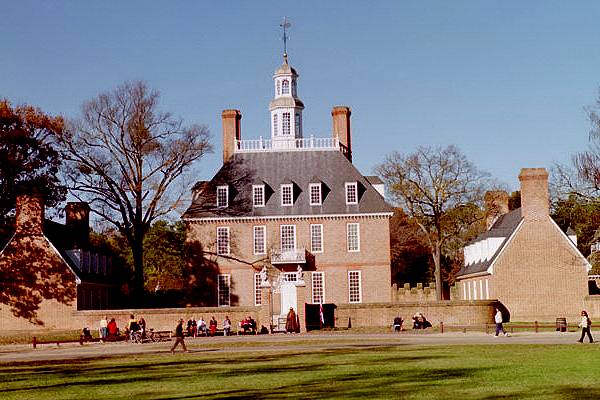
November 24: (BELOW) The Governor's Mansion has been restored to its incredibly ornate original state. Around the foyer and along the main stairway are literally hundreds of muskets and pistols, as the Colonial Governor always wanted to keep a tight grip on the tools of law enforcement. The walls of the governor's office, upstairs in front (where the balcony is), were covered in restored embossed, gilded leather. The woodwork and tapestries were exquisite. No wonder the colonial citizens got restless...

On the back (north) side of the Governor's Mansion is a beautiful gilded crest symbolizing Virginia's ties to the British Motherland: It features a lion representing England and a Unicorn representing Scotland. The colors are much more vivid than this image conveys. The gardens are vast, with a long well-shaded canal in a ravine as well as a labyrinth made of hedges -- which we didn't have time to see, unfortunately.


As we were leaving the Governor's Mansion late in the afternoon, one of the horse-drawn carriages passed by.


November 25: Among the ultra-quaint shops along Duke Gloucester Street, the main street of Colonial Williamsburg, is the Apothecary, indicated by the sign with the reddish spot.


The Wren Building, on the east edge of the campus of the College of William and Mary, the oldest institution of higher education in North America. (It was chartered in 1693, just five years after England's "Glorious Revolution.")


About ten miles southeast of Williamsburg is Jamestown, where the first colony in Virginia was founded in 1607. Near the entrance gate we saw an adult bald flying; it was a cold and windy day. This is a statue of John Smith, who wedded the Indian princess Pocahontas. In back is an Episcopal Church built on the site of the original church in Jamestown; this structure dates from the 1870s.


Nov. 24: About fifteen miles east of Williamsburg is Yorktown, where General Cornwallis surrendered his British army to General Washington and General Lafayette in October 1781. This monument to the battle that sealed the triumph of the American Revolution is situated on a hill overlooking the James River. A plaque commemorating the French soldiers who died there was placed by French President Valery Giscard d'Estaing during a Bicentennial ceremony in 1976.


[NOT UPLOADED] Here we are standing on the fishermen's pier on the southernmost (artificial) island of the Chesapeake Bay Bridge-Tunnel, one of the most amazing engineering feats of the 20th Century. It was a very nice day, but we didn't see as many interesting birds as we had hoped for.


Rainbow