home

Baseball cities:
Attendance and population

Updated:
First posted: June, 2003


Background

Much of the argument surrounding the issue of whether Washington was the best alternative location for the Montreal Expos is based on demographics and the geographic distribution of other professional sports franchises. Is the population of the Washington-Baltimore region sufficient to support two baseball franchises? This newly-updated page lays out the key facts, and includes -- for the record -- an analysis of the attendance-population relationship that I made in 2003, as well as a tirade that is now moot, thankfully. Some would argue that Washington and Baltimore are distinct urban areas separated by an hour or more driving time under normal conditions, but we will leave that aside for the moment. As shown by the following table, the fears that the Washington-Baltimore region could not support two baseball franchises appear to have been grossly misplaced. There was only a small decline in Baltimore Orioles attendance, while total attendance for the Washington Nationals' inaugural year (2,692,123) was nearly four times that of the Montreal Expos in their final year (748,550). In other words, the franchise relocation yielded a 1.8 million net increase in total Major League Baseball attendance.

Baseball attendance in multi-team metropolitan areas
City / team Population Miles between stadiums Total annual attendance
2001 2002 2003 2004 2005 2006*
New York 21,199,865 10 5,923,237 6,270,645 5,606,199 6,093,613 6,872,652 1,633,516
Yankees 3,264,907 3,465,807 3,465,600 3,775,292 4,090,440 928,275
Mets 2,658,330 2,804,838 2,140,599 2,318,321 2,782,212 705,241
Los Angeles-Anaheim 16,373,645 32 5,018,062 5,436,802 6,199,720 6,863,960 7,008,366 1,585,157
Dodgers 3,017,143 3,131,255 3,138,626 3,488,283 3,603,680 873,903
Angels 2,000,919 2,305,547 3,061,094 3,375,677 3,404,686 711,254
Chicago 9,157,540 10 4,545,637 4,370,007 4,902,154 5,100,721 5,443,096 1,283,692
Cubs 2,779,465 2,693,096 2,962,630 3,170,184 3,100,262 664,904
White Sox 1,766,172 1,676,911 1,939,524 1,930,537 2,342,834 618,788
San Francisco-Oakland 7,039,362 17 5,466,454 5,423,014 5,481,494 5,460,380 5,250,079 1,505,183
San Francisco Giants 3,311,958 3,253,203 3,264,898 3,258,864 3,140,781 799,942
Oakland Athletics 2,154,496 2,169,811 2,216,596 2,201,516 2,109,298 705,241
Washington-Baltimore 7,608,070 36 3,094,841 2,682,439 2,454,523 2,744,013 5,316,927 934,810
Baltimore Orioles 3,094,841 2,682,439 2,454,523 2,744,013 2,624,804 607,805
Washington Nationals X X X X 2,692,123 327,005

* First six weeks. Only about one third of Washington Nationals games were at home.

SOURCE: ESPN


NOTE: This section was originally written in 2003. Some of the text [in brackets] has been edited to reflect the fact that baseball in Washington is now a reality.

Analysis (2003)


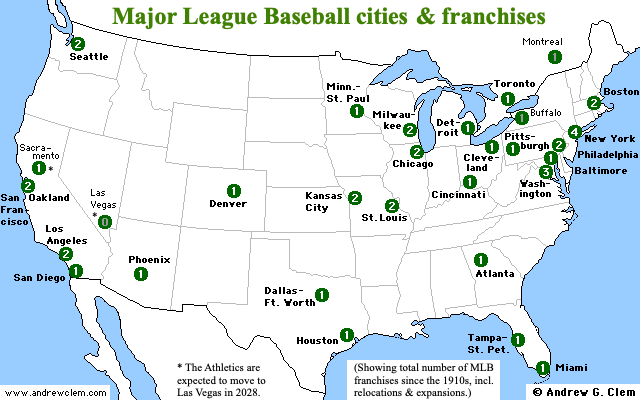
Cities chart Other cities besides Washington have suffered to some extent from pro sports deprivation. Portland is the second leading contender in the competition for the Expos franchise, but there are major questions about whether public and private resources in that city (and state) are sufficient to pay for the movable-dome stadium that would be necessary in that rainy climate zone. San Juan, Puerto Rico currently is without any U.S. pro sports franchises, and the puertorriqueños would probably welcome a baseball team with open arms. However, it is far too hot and stormy there in the summer, and average household income is not sufficient to generate enough income to pay major league salaries. After a couple games that were almost sold out in April 2003, attendance at Expos games in Puerto Rico declined to an average of about 14,000. That was not much more than back home in Montreal, where fan enthusiasm tragically all but died. Washington, [in contrast,] is overflowing with wealth and has a large population that is eager to see baseball games, with many thousands of potential fans who [for many years were] tantalized by the sight of Baltimore games that are just too far away to see on a regular basis.

As the chart on the upper right illustrates, by the most conservative assumptions, there is a baseball attendance "gap" of at least 20,000 fans in the Washington-Baltimore area. That is a fair "ballpark" estimate of how many people would probably be willing to see a ball game on a regular basis if it were convenient to get there, and it represents a huge unmet demand for sports entertainment that could never exist in a truly free market. (NOTE: If we allowed for a bigger intercept term and greater degree of curvilinearity in the functional relationship, the gap would increase to 25,000 or more.) Modestly assuming an average ticket price of $20 (slightly more than what Baltimore took in last year), that represents a total "deadweight" revenue loss of $400,000 per game, or $3.24 million per 81-home-game season. Add to that the television advertising revenues, merchandise licensing fees, etc., and it quickly becomes apparent what a huge fortune Major League baseball is forgoing every year. Why? To protect the monopoly asserted over the Washington area by the owner of the Baltimore franchise, Mr. Peter Angelos, a wealthy trial lawyer with strong political connections to the Maryland Democratic party. If the new stadium [had been] located in Northern Virginia, there would be only a negligible effect on the Orioles' ticket and advertising revenues. [Since] the stadium [will be] located in the District, however, Mr. Angelos [does] have a plausible basis for demanding compensation from the new Washington franchise owners for "infringement" upon his franchise's territorial "rights."

Farsighted entrepreneurs -- men and women who create new wealth by accepting risk -- know that business deals are not always a zero-sum game. Indeed, it is entirely possible that the added excitement generated by a new team in Washington or Northern Virginia would stimulate attendance in Baltimore, rather than drain away from it. The Orioles' front office argues that the Washington-Baltimore area can't support two baseball teams. Look at the six cities with a population of 2.5 to 3 million (comparable to Baltimore), and look at their teams' attendance: they average about 31,000, which is almost the same as the Orioles' current attendance. Contrary to what Peter Angelos claims, studies cited in the Washington Post estimate that no more than ten percent of the fans at Orioles' games come from the Washington area. There is no reason why the Washington-Baltimore area could not meet or surpass the above-average attendance registered in the San Francisco-Oakland area, in which case we could be talking about an average attendance in D.C. of 30,000 or even 35,000 per game. The comparison between Washington-Baltimore and San Francisco Oakland is appropriate not only because of the similar total population, but because these can be regarded as "twin cities."

The following table highlights the glaring omissions in pro sports franchises (baseball in D.C., football in L.A.), as well as a few cases of unusually high or low attendance. Note that these data treat the Washington-Baltimore area as a single "consolidated statistical metropolitan area (CSMA), in keeping with Census Bureau criteria


Cities with professional sports franchises (and some "wanna-be's")
RankCity / Metro areaPopulation
(2000 Census)
Pro sports franchisesAverage baseball attendance, 2002
MLBNFLNBANHL
1New York, NY--NJ--CT--PA CMSA21,199,865222379,282
2Los Angeles, CA CMSA16,373,645202267,121
3Chicago, IL--IN--WI CMSA9,157,540211155,230
4Washington--Baltimore, DC--MD--VA--WV CMSA7,608,070(2)21133,122
5San Francisco--Oakland--San Jose, CA CMSA7,039,362221166,951
6Philadelphia, PA--NJ--DE--MD CMSA6,188,463111120,484
7Boston, MA--NH--ME--CT CMSA5,819,100111132,717
8Detroit, MI CMSA5,456,428111118,795
9Dallas--Fort Worth, TX CMSA5,221,801111129,404
10Houston, TX CMSA4,669,571111031,078
--Toronto, ONT4,263,75711 *1120,221
11Atlanta, GA MSA4,112,198111032,142
12Miami, FL CMSA3,876,380111110,038
13Seattle, WA CMSA3,554,760111043,712
--Montreal, QUE3,326,510(0)1 *1110,031
14Phoenix, AZ MSA3,251,876111139,494
15Minneapolis--St. Paul, MN--WI MSA2,968,806111123,759
16Cleveland, OH CMSA2,945,831111032,308
17San Diego, CA MSA2,813,833110027,415
18St. Louis, MO--IL MSA2,603,607110037,176
19Denver, CO CMSA2,581,506111133,800
20San Juan, PR CMSA2,450,2920000 
21Tampa--St. Petersburg, FL MSA2,395,997110113,157
22Pittsburgh, PA MSA2,358,695110122,591
23Portland, OR--WA CMSA2,265,2230010 
24Cincinnati, OH--KY--IN CMSA1,979,202110023,197
25Sacramento, CA CMSA1,796,8570010 
26Kansas City, MO--KS MSA1,776,062110017,182
27Milwaukee, WI CMSA1,689,572111024,311
--Other cities with professional sports franchises: 0656 
KEY:Abnormally lowUnusally high

Numbers in parentheses changed since 2003. Asterisks denote Canadian Football franchises.

SOURCES: U.S. Bureau of the Census; Statistics Canada; Street & Smith's Baseball 2003 Yearbook


NOTE: This section was originally written in 2003. Some of the text [in brackets] has been edited to reflect the fact that baseball in Washington is now a reality.

A tirade that is now moot


If we were to drop for a moment the charitable assumption that Baltimore and Washington should be regarded as a single metropolitan area, there would not even be a debate. With a total population of well over four million, Greater Washington is bigger than half of the cities that currently have major league baseball franchises. Conclusion: The contrived deprivation of baseball from the Washington area [was] utterly unjustified and [could not] go on!

The point of all this is not to whine about how much D.C.-area fans "deserve" their own baseball team, but rather to restate a fundamental principle that should be obvious to everyone: Sports enterprises that receive public sector subsidies must be held accountable for their actions. If the front offices don't abide by basic norms of fair play, then it really doesn't matter whether the players do or not. Once we set aside passions, it becomes apparent that the relocation issue can be resolved through honest, open negotiation. Washington and Baltimore baseball fans should learn to see each other as friendly rivals, not jealous adversaries. Ultimately, however, the decision will be up to the 29 major league baseball franchise owners. Unless the owners of franchises in smaller markets can be persuaded to stop tolerating Mr. Angelos's wanton abuse of baseball's exemption from antitrust laws, the only remedy Washington area fans may have would be in Congress.

For further information, check the links at the bottom of this page. To register your opinion on the subject, contact your local elected officials (if you live in the D.C. metro area), write letters to your newspaper, and send a letter to:

Allan H. (Bud) Selig, Commissioner
The Office of the Commissioner of Baseball
245 Park Avenue, 31st floor
New York, NY 10167
(212) 931-7800

Thanks, Bud!


Baseball!

Copyright © 2006 Andrew G. Clem. All rights reserved. Use of this site indicates your agreement to the Terms of Use.