This Web site is dedicated to the proposition that baseball is the social "glue" that keeps our fair republic united.
Welcome,
baseball fans!
Visit me on

(Please indicate that you are a baseball fan.)

 Introduction :
How to navigate baseball Web pages, FAQs for newcomers, etc.
Baseball blog archives (2002- )
Stadium updates log (u.c.: 2013- )

 feed (
![[Valid RSS]](Art/valid-rss.png "Validate my RSS feed") )
)
Support this site:

Sponsor a stadium page, or donate or advertise)
Baseball blogs
Baseball Musings by David Pinto
Mop Up Duty (Canada!)
Baseball Crank
Baseball In-Depth (Brad Templeman)
Bleed Cubbie Blue
Timeless Baseball, focus on WWII era (George Case)
 Doug Wilson Baseball general topics, history
General sports blogs
Off Wing Opinion, by Eric McErlain (hockey focus)
# = Not very current; few if any posts from the last few months.
Updated !
Baseball sites
Reference, etc.
Major League Baseball:
Scoreboard ~
Standings
Statistics ~
Players
Society for American Baseball Research
Business of Baseball (SABR)
heavyhitter.com (links)
Baseball Links
Baseball Library
Modern Era Baseball
Baseball Reference Stats and info
Baseball Almanac
Baseball Statistics
Baseball Hall of Fame
logoserver.com, old team logos
hittrackeronline.com HR distances, etc.
Today in Baseball
Tom Stanton (author)
Ballparks
New! ballparksavvy.com
Baseball Cube
baseballparks.com by Joe Mock
Lowell Prescott's Ballpark Magic
Paul's Ballparks
Frank's BallParks
Project Ballpark by Paul Healey
Stadiums on Antique Postcards
Ballpark pens by William Hartel (semi-retired?)
Ira Rosen's Stadium Views
Ballpark Reviews
Ballparks by Munsey & Suppes.
Ballparks of Baseball
Federal League Ballparks ?????
Stadiums of NFL (Football!)
Satellite photos, via yahoo.com
Sports Temples, Boston Public Library (archival photos)
Library of Congress (archival photos, etc. ???)
newballpark.org -- Oakland (?) Athletics
Minor Leagues
Minor League Ballparks (retired)
Valley League Baseball (Shenandoah)
Cuban baseball
Negro League Ball Players Assoc.
Baseball politics
Field of Schemes Anti-public funding of stadiums
League of Fans, by Ralph Nader.
WANTED: Your photos!
 I invite fans of this Web site to share any photos which they have taken of the major league ballparks. There are currently no photos on the pages for the ones listed below, most of which are no longer in existence. I would also be glad to include photos of stadiums that served as "neutral venues," or photos that are of better quality than the current ones...
- Astrodome
- Baker Bowl
- Braves Field
- Colt Stadium
- Crosley Field
- Ebbets Field
- Exhibition Stadium
- Forbes Field
- Jarry Park
- Memorial Coliseum
- Metropolitan Stadium
- Mile High Stadium
- Milwaukee County Stadium
- Polo Grounds
- Seals Stadium
- Shibe Park
- Sick's Stadium
- Sportsman's Park
- Wrigley Field (L.A.)
Please Contact me (via e-mail) if you would like to share some of your "photographic memories" with other fans.
Photographer credits:
I always credit the original photographers, and am much obliged to the following people:
- Andrew Owen
- Dave Givens
- Al Kara
- John Minor
- Glenn Simpkins
- Paul Dimitre
- John Crozier
- Joe Johnston
- Brian Vangor
- Brian Hughes
- Mario Vara III
- Mike Zurawski
- Gavin Dow
- Marc Myers
- Phil Faranda
- Lonnie Spath
- Fritz Roberson
- Keith Kirkpatrick
- Edward Findlay
- Howard Corday
- William R Kooney
- John Mikulas
- Michael Hoecker
- Wayne Whitham
- Jeff Stark
- Bill Blake
- John Clem
- Clifford Nance
- Kris Schneider
Disclaimer
This web site has no connection to Major League Baseball or any of its affiliated franchises. The information contained herein is accurate as far as the author knows, and the opinions expressed are his alone.
Postseason scores below!!
September 11, 2026 [LINK / comment]
Baseball ownership intrigues in Los Angeles!
After several years of grumbling by Angels fans that team owner Arte Moreno was not doing anything to improve the team, a potential new owner recently emerged: Stan Kroenke. He has pledged to build a new stadium with private financing, but the details are very hazy. It's not even clear whether he intends to remain on the same plot of land that the Angels have occupied since 1966. See ESPN.com.
On the PBS News Hour last week, an investigative journalist from L.A. named Pablo Torre reported on the legal peril confronting the principal owner of the Dodgers, Mark Walter. He allegedly violated securities law when he borrowed money to buy the Dodgers franchise in 2012. (The previous lead owner, Frank McCourt, had to declare bankruptcy.)
More and more page updates!
Hearing that news about the Dodgers' owner prompted me to check the MLB Franchises page, and noticed that I had erroneously listed Mark Walter as "Mark Walters" (plural), so I corrected that. (The purchase of the Angels by Stan Kroenke is still pending.) While I was at it, I made a few other corrections, such as updating the names of some of the stadiums on that page such as Oracle Park and Daikin Park. (It's hard to keep up with those changes on so many pages!)
Continuing in my laborious efforts to bring various stadium comparison pages up to date, I have fixed the formatting and content problems on the Stadium milestones page.
I also made minor tweaks to the Turf page and the Stadiums by class page.
Stadiums in Limbo page now reflects the facts that demolition of RFK Stadium was completed last year, and that Oakland Coliseum is essentially abandoned, used only as an occasional soccer venue.
Finally, both the Dolphin Stadium and Yankee Stadium pages have been corrected and made more conformable to the new standard format.
Nats resume plunge
Speaking of L.A., The Washington Nationals got swept by the Dodgers in a 3-game series there last week. In the first game, rookie starting pitcher Jackson Kent had two good innings and then his control slipped and the Dodgers jumped on the opportunity. Meanwhile, the Nationals managed to blow every scoring opportunity they had, while the bullpen officially set an MLB record for blown saves, with 38. The less said about the ongoing losing streak the better...
This came after an uplifting moment for the Nats when they faced the Braves to close out their home stand in Washington on Tuesday, September 1. On that day, all teams rosters expanded, and two Nats rookies were called up to play in their first-ever MLB games. With his parents watching in the stands, Yohandy Morales hit his first major league home run, helping the Nats to win, 9-5. Credited with the win was Jared Simpson, who pitched three innings in relief of Jake Irvin, likewise in his MLB debut.
August 31, 2026 [LINK / comment]
After another bullpen meltdown, the Nats redeem themselves
The Washington Nationals showed promising signs that they really had pulled out of their August nose dive this weekend, winning the first two games against their division rivals from Miami, and [had] a 2-0 lead going into the top of the 9th inning. And then, everything suddenly fell apart. Max Kranick gave up a single and two walks to load the bases and left the game with one out, and was charged with all 3 runs that later scored and became the losing pitcher. His replacement, Tom Cosgrove, hit the first batter he saw with a pitch, making it a 2-1 game, and then a sacrifice fly to left field allowed the tying run to score. [But] the throw to 3rd base was mishandled, with Cosgrove not in position to back it up, allowing the Marlins to take the lead. Absolutely disgusting performance! The next batter walked and then bamboozled Cosgrove by [unexpectedly stealing] 2nd base, while the runner on 3rd base scooted home to score. To top it all off, the next batter, Otto Lopez, hit a home run to give the Marlins a 6-2 lead. Un-effing-believable!!! So Cosgrove he was charged with a blown save in one of the most embarrassing moments in Nationals history.
In today's game, the Marlins took a 3-0 lead in the 4th inning, and it looked liked they were going to split the 4-game series. But the young hustling National named Daylen Lile had other plans. Having hit 3 homers over the past 4 games and being named National League Player of the Week, he led off with a single in the 1st inning, and then hit 2-run homers in both the 5th and 7th innings. That crazy guy almost single-handedly lifted the Nationals from the pits of despair to the heights of comeback glory! Pitching for the Nationals was a succession of relievers and recently-acquired pitchers. Will Dion pitched the first 3 innings, and former Blue Jay Matt Waldron pitched the 5th, 6th, and 7th innings, being credited with the win. A guy named Erik Tolman came in to pitch in the 8th inning, and promptly loaded the bases with 3 straight singles. Oh, no! Here we go again! But Blake Butera kept him on the mound, perhaps wanting to let the guy prove himself or perhaps just not having any good alternatives. I cringed in horror, anticipating the worst. But guess what? Tolman struck out the next batter and then got out of the inning intact as the batter grounded into a double play. Then in the 9th inning, he struck out all 3 batters! Talk about major-league nerve! I hope this was a sign of better things to come for the Nationals' mostly-deplorable bullpen. Final score: Nats 6, Marlins 3.
The Nats' bullpen: worst ever?
The crushing defeat at the hands of the Marlins on Saturday reminds us that the Nationals hold the dubious distinction of leading the major leagues in total blown saves: 35. I forget what the all-time record is, but the Nats are getting dangerously close to it. The Nationals and the Rays are tied for first place in the majors with 69 save opportunities, and whereas the Rays lead the majors in saves (with 54), the Nationals are tied in 18th place in saves (with 34). (Blown saves equals save opportunities minus saves.) Let's take a look at some of the most egregious cases this year in which the Nats' bullpen not only faltered, but suffered a total meltdown in the ninth inning, or later:
The Nationals' worst 9th- (or extra-) inning reversals in 2026 through August
| Date |
Opponent |
Home or Away? |
Opp. 9th-inning runs |
Nats' 9th-inning runs |
Opp. total runs |
Nats' total runs |
Nationals' pitchers at fault |
| May 18 |
New York Mets |
Home |
0 * |
0 * |
16 |
7 |
Paxton Schultz (L) |
| June 10 |
San Francisco Giants |
Away |
5 ** |
1 |
11 |
10 |
Mitchell Parker (L) |
| June 23 |
Philadelphia Phillies |
Home |
8 |
1 |
14 |
9 |
Brad Lord (L, BS) |
| June 24 |
Philadelphia Phillies |
Home |
2 |
0 |
5 |
4 |
Richard Lovelady (L, BS) |
| July 10 |
New York Yankees |
Home |
3 |
0 |
5 |
3 |
Matt Krook (L, BS) |
| Aug. 15 |
New York Mets |
Away |
2 |
0 |
5 |
4 |
Yovanny Cruz (L, BS) |
| Aug. 30 |
Miami Marlins |
Home |
6 |
0 |
6 |
2 |
Max Kranick (L),
Tom Cosgrove (BS) |
* The May 18 home game against the New York Mets was decided in the 12th inning, when Nats reliever Paxton Schultz gave up 5 hits and 7 runs, and then infielder Jorbit Vivas came in to pitch, giving up 3 more runs, for a total of 10 runs in that inning.
** In the June 10 game in San Francisco, the Giants scored 5 runs in both the 8th AND the 9th innings.
It is remarkable that none of those names are repeated, i.e., the failures of Nats' relief pitching is widely distributed. In most cases, the pitcher at fault recorded both a loss (L) and a blown save (BS), but on June 10 the Nationals had a 10-6 lead going into the bottom of the 9th inning, which is not a save situation, so Mitchell Parker was charged with a loss but not a blown save. In the game on Saturday night, Max Kranick loaded the bases and was charged with all 3 runs that later scored, thus becoming the losing pitcher. After Tom Cosgrove came in to pitch, the Marlins took the lead, so he was charged with a blown save.
Stadium page updates: Florida!
Over the last three days I have updated the three stadium pages for Florida: Tropicana Field, Dolphin Stadium, and Loan Depot Park. They are now all consistently formatted, with a section describing the locations and attractions of the respective cities, along with a composite photo of Miami -- but not St. Petersburg-Tampa, which I have yet to visit. This completes my project of updating all the regular MLB stadium (past and present) pages, which I began in early July. So when am I going to update the pages of the various stadiums used on special occasions for MLB games, or other significant minor league ballparks, such as Hamtramck Stadium? (After all, I recently did so for the Field of Dreams in Iowa.) Good question! Actually, I did pay an in-person visit to Hamtramck Stadium, located in an enclave within Detroit, so that will probably be first one. But that still leaves Rickwood Field in Birmingham, Alabama, among others...
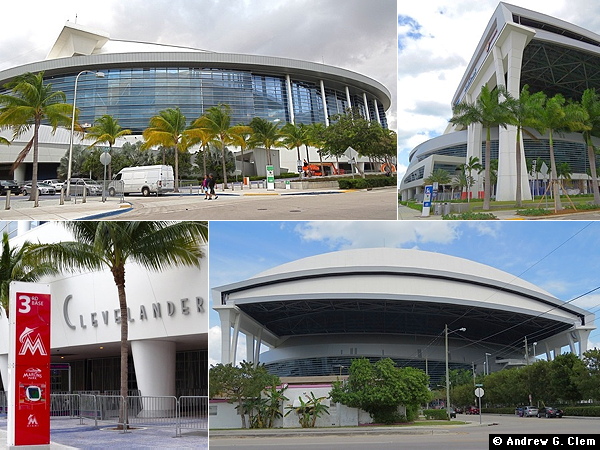
Scenes from my two visits to what was then called "[Marlins Park" (NOT Dolphin Stadium!)]*** in February 2017.
And just in case that semi-tropical scenery isn't enough for you, here are some scenes from elsewhere in Miami and (with a mouse rollover) further south in the Everglades:
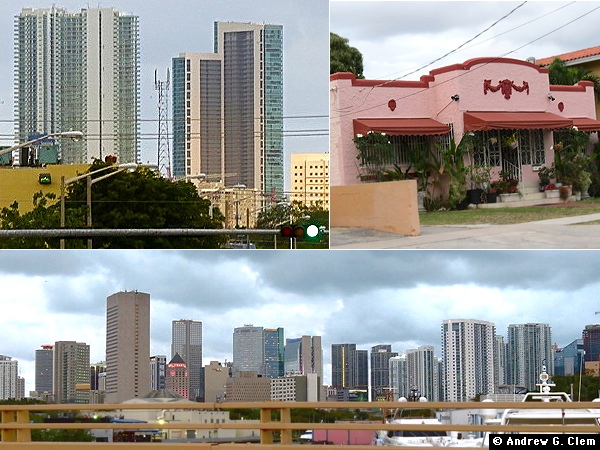
Miami high-rises as seen from a bridge across the Miami River, and one of the "Little Pink Houses" for you and me (cue John Mellencamp), also in February 2017. Ain't that America??!
And speaking of page updates, the Washington Nationals page now has all the data up through the month of August, during which the Nats won a paltry 11 games and lost 18. There are lots of new players' photos (in miniature size), taken in the game I saw on August 8.
Scherzer climbs strikeout rankings
In the Toronto Blue Jays' 7-0 win over the Seattle Mariners on Saturday, former Nats pitcher Max Scherzer surpassed Gaylord Perry (3,534) in the all-time list of strikeouts, with 3,535, and now ranks #9. (He recently surpassed Walter Johnson, who struck out 3,508 batters in his illustrious career.) Don Sutton ranks #[7] with 3,574 strikeouts, [while Justin Verlander ranks #8 with 3,554]*** and it's possible Max could reach that number this year. But will he continue pitching in 2027? That game was only his second win of the year (2-7 record), since he hardly pitched at all from May through July, and his ERA is 6.16. In any event,
Well done, Max!
*** "After further review," I had to make multiple corrections the next day, indicated above with brackets around the affected text. That ought to teach me to try to squeeze in a summary of the preceding month's action before the first day of the next month!
August 28, 2026 [LINK / comment]
Nationals hit rock bottom, and then bounce back up!
After blowing the lead and getting beat by the Marlins in Miami on Friday one week ago, the Washington Nationals ended up getting swept by the host team. The Nats scored 2 runs in all 3 games, while the Marlins improved in each successive game. Starting pitcher Jake Irvin took the loss on Saturday, and rookie Jackson Kent did so on Sunday. Neither was really to blame, however, it was just the lack of run-scoring support by the erstwhile offensive juggernauts of the 2026 season.
Then the Nats returned home to face the Colorado Rockies, and Nationals Park looked banged up from the rock music concerts that had been held there during the team's 9-game road trip. Cade Cavalli was on the mound, and with the Nats' bats being silent in the first four innings, he found himself in the unusual position of being behind 2-0. But in the bottom of the 5th inning, the Nats staged a 5-run rally, adding multiple runs in the next 3 innings as well, and won the game handily, 13-3. Daylen Lile was the offensive spark plug, batting in 5 runs, with a home run to boot. But that reassuring victory carried no momentum with it, as the Nats lost 3-1 on Tuesday and then 13-1 on Wednesday. Andres Chaparro homered to give the Nats a 1-0 lead in the 2nd inning, but the Marlins hit two 2-run homers in the 4th inning, and piled on 9 more runs in the latter innings. To spare his bullpen further agony, manager Blake Butera put infielder Jorbit Vivas on the mound to finish the 8th inning, which was rather ugly, and then the 9th inning. That game had to be one of the real low points of the Nationals' disappointing 2026 season, with a perilous consequence: the 5th-place New York Mets pulled to within just one game of the Nationals in the NL East race! (The Mets were 60-72 after the Tuesday games, and the Nats were 62-72.) But somehow the Nats gathered their wits for the final game of of the series on Thursday afternoon. Starting pitcher Jake Irvin walked the bases loaded in the 1st inning, but got out of it intact. Then the Nats took a quick 2-0 lead on 3 singles and a timely sac fly by Brady House. Daylen Lile and Keibert Ruiz homered in later innings, and the Nationals won it, 7-1, thus splitting the series 2 games apiece. Those were the first games that the Nats had won with somebody other than Cade Cavalli as starting pitcher since Sunday, August 9!
This evening the Nationals welcomed (?) the Miami Marlins to Washington, The Marlins had beaten the Nationals in their last 7 matchups, almost as if they had a secret key to render the Washington players defenseless. But this time the Nats pulled off some "magic tricks" of their own, starting with a wild pitch thrown by Eury Perez in the 3rd inning that allowed 2 Nats baserunners to score. Catcher Joe Mack's throwing error accounted for the second run. That instantly broke the tension in the Nats dugout. Daylen Lile walked, and then Brady House crushed a home run way up beyond the Red Porch seats in left-center field, giving the Nats a 5-1 lead. WOW!! That ball was estimated to have gone 474 feet, one of the longest home runs this year, and one of the longest ones in Nationals Park history!!! In the bottom of the 7th inning, catcher Harry Ford hit a solo homer, and then the Nats piled on 3 more runs, leading to a very satisfying 9-2 victory over the Marlins. Starting pitcher Jackson Kent got his first major league victory, finishing seven innings with 106 total pitches. The promising signs he displayed in his previous three starts were borne out, and he may become part of the Nats' rotation next year! Meanwhile, the Mets lost again, providing the Nats with a bit of breathing room in the race to avoid the proverbial cellar. If the Nats can pull themselves together, they can at least end this big letdown of a season reasonably close to the .500 mark, and maybe even pull ahead of the Marlins to take 3rd place honors. Call me a dreamer...
[Tonight's game was the last of ten Nationals games to be broadcast by Gray Media local TV stations this year. That innovative approach brought Major League Baseball to a wider audience, and is to be warmly applauded. Likewise for the NBC (and Peacock) coverage of MLB games this year, mostly on Sundays. Hopefully both such TV broadcasting arrangements will be repeated next year. (If there IS a next year for baseball, that is... The possibility of a players' strike or a lockout by the owners seems to be growing all the time.  )]
)]
MLB returns to Williamsport, PA
This past Sunday, the annual "Little League Classic" game was played at Bowman Field in Williamsport, Pennsylvania. (It's located in the north-central part of the Keystone State.) I was surprised to learn that, since the first such event in 2017, it was the ninth Major League Baseball game to be played there! So I updated the Bowman Field page accordingly. Technically, it is now called "Journey Bank Ballpark at Historic Bowman Field," after a few years of "Muncy Bank Ballpark at Historic Bowman Field" being the formal name. Anyway, the Atlanta Braves beat the Milwaukee Brewers 4-2. It was a possible preview of a postseason matchup, with the NL East leading team beating the NL Central leaders.
In another preview of a possible postseason matchup, Chris Sale of the Atlanta Braves threw a 9-inning shutout against the L.A. Dodgers in Truist Park last night. In the bottom of the 1st inning, the Braves' Drake Baldwin swung at the first pitch he saw, and he put that ball way up into the right field seats. It was the only run scored in that entire game! Yoshinobu Yamamoto (ERA 2.56) pitched extremely well for 6 1/3 innings, but took the loss nonetheless. A classic pitchers' duel!
A few more page updates
Both the Anomalous stadiums page as well as the Stadiums by class page have been updated to account for the awkward transitional status of Sutter Health Park, the demolition of RFK Stadium, the conversion of ex-Turner Field and ex-Globe Life Park to serve as football venues, and a few other recent changes.
Over the weekend, I plan to finish the stadium page updates for Florida, and that will complete the MLB phase of my page update endeavors! (Eventually, I'll do likewise for the many temporary or anomalous stadiums as well. )
Is that the Astrodome? Nope!
The other day I was watching the movie Selena on the Pluto streaming service, and was intrigued by the scenes where the title character (played by a young Jennifer Lopez) was (supposedly) performing a concert in the Astrodome! But it sure didn't look like the Astrodome to me, as the grandstands appeared to be arranged in perpendicular fashion to each other, whereas it should have been a continuous circle. After checking the IMDb website, I learned that those scenes were actually filmed a 125 or so miles to the west of Houston -- in the Alamodome of San Antonio!
New stadium deals in K.C. & Tampa!
Over the past week, both the Kansas City Royals and the Tampa Bay Rays announced stadium deals with local government authorities, and I'll have a lot more to say about that soon.
August 21, 2026 [LINK / comment]
MLB returns to the Field of Dreams
For the third time, on [the 13th of] August a Major League Baseball game was played at (or near) the Field of Dreams movie site near Dyersville, Iowa. The Minnesota Twins were "hosting" the Philadelphia Phillies, but there wasn't much doubt which way things were headed. On the third pitch of the game, Kyle Schwarber blasted a home run into the corn fields beyond right field, and the Phillies added another run before the Twins came to bat. In the 4th inning Schwarber homered again, and Brandon Marsh added two more runs with a homer in the 7th inning. Final score: Phillies 7, Twins 1.
This was the first time that an MLB game had been played at the Field of Dreams since the new permanent stadium was built there earlier this year. I made a point to visit it in June, on my way out west, and my photos were very useful in capturing the details. Interestingly, the outfield fences, light standards, scoreboards, dugouts, and even the stadium outline were virtually identical to the temporary stadium that had existed there from 2020 through 2022. (When I visited in 2024, I was surprised to see that there was no stadium at all; the entire structure was temporary in nature, and was removed after the 2022 game.)
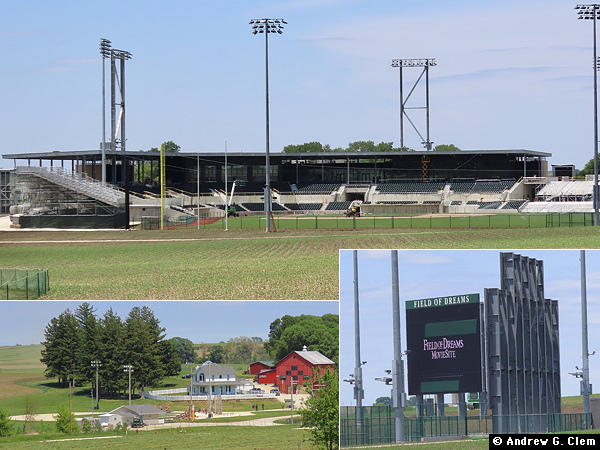
Some views of both the new stadium at the Field of Dreams, as well as the farm and ballfield where most of the movie was shot.
Diagram update!
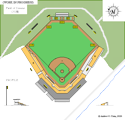
So, needless to say, I had some diagram revisions to take care of, which you can now see on the Field of Dreams page! For the most part, it's fairly accurate, but I noticed some discrepancies between the photos that I took there two months ago compared to the video images of the game that I saw. So, there are no doubt a few corrections that will need to be made...
Next year the Kansas City Royals will play as "host" to the Boston Red Sox at the Field of Dreams. Unlike this year's exclusive Netflix TV arrangement, the 2027 game will be broadcast nationwide on NBC Sports, which does not require a paid subscription to view. Yay! See royalsreview.com.
Cade Cavalli: the Nationals' new ace pitcher!
The Washington Nationals have been in a terrible slump for over a week, so let's accentuate the positive. In the only two games the Nats have won since August 11, the starting pitcher was Cade Cavalli, and both times he reached the double-digits in strikeouts, going 8 and then 6 innings without giving up a run. In the August 19 game against the Texas Rangers in Arlington, he had a no-hitter going until the 6th inning! Earlier in the season he was mostly very good but had a few bad outings. But since the Nats' previous ace pitcher Foster Griffin was traded away to the Cleveland Guardians on August 3, Cavalli has stepped up and assumed a truly dominant role on the mound. He has had seven consecutive "quality starts," i.e. 6 or more innings pitched with 3 or fewer earned runs. With an ERA of 3.22, he currently ranks 15th in the major leagues, catching up on his former team mate who is now in Cleveland. (Griffin's ERA is 3.18, ranked 13th.)
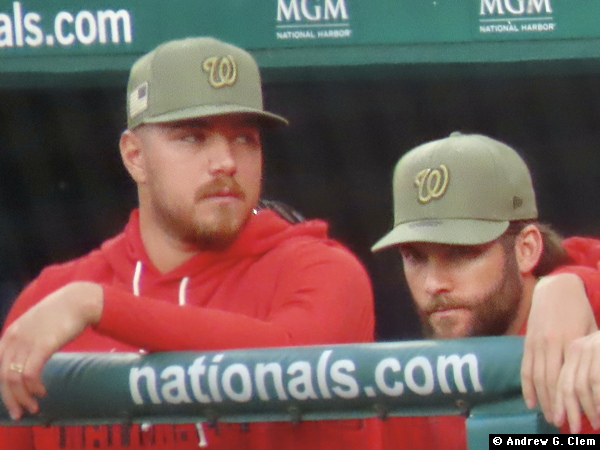
Cade Cavalli (L) and Foster Griffin (R) in the dugout during the Nats' game against the Baltimore Orioles on May 15.
Otherwise, the Nats keep losing
Unfortunately, Cavalli's rise to excellence has coincided with a sharp decline in his team mates' performance. Since the August 11-13 series with the Cubs, the Nats have been shut out twice, and only once have they scored more than 4 runs. Andres Chaparro and Abimelec Ortiz continue to hit home runs, but otherwise not much is happening. James Wood remains on the injured list, and C.J. Abrams has been slumping badly at the plate. Because of his often-shaky defensive performance at shortstop, he is starting to play at second base (or as designated hitter), which is probably not good for morale.
To sum up the recent series, the Nationals lost the first two games to the Cubs and then totally dominated the visitors 7-0 on August 13 when Cavalli was on the mound. Then they traveled to New York, where the hungry Mets took every opportunity they could, sweeping the Nats in 3 games straight. The Saturday, August 15 game was especially disheartening because the Nats had a 4-3 lead going into the bottom of the 9th, whereupon relief pitcher Yovanny Cruz gave up a walk, a single, and a double before getting the first out, and then Francisco Lindor hit an RBI single to win the game. Jubilation in Queens!
The August 18-20 series in Arlington, Texas was strange, because all three games were shutouts. On Tuesday the Nats' rookie pitcher Jackson Kent gave up 5 runs to the Rangers in the first 3 innings, which was 4 more than the [home team] ended up needing. On Wednesday, the 3rd-inning home run by Jose Tena was all the Nats really needed, but the 3-run blast by Andres Chaparro in the 7th inning was a nice bit of insurance. Nats 6, Rangers 0. On Thursday Andrew Alvarez had another decent outing, but didn't get credit for it, as the Nats only got one hit the entire game. Final score: 2-0.
And then in Miami tonight there was another tension-filled pitchers' duel, and the Nats took a 1-0 lead when Keibert Ruiz homered in the 6th inning. But the Marlins took a 2-1 lead in the bottom of the 8th, as Tom Cosgrove proved less than effective as a reliever. In the top of the 9th, hopes were fading fast, when Daylen Lile hit an ultra-clutch RBI single to tie the game. But in the bottom of the inning, Clayton Beeter loaded the bases after giving up a single and then committing a throwing error on a bunt single, after which he intentionally walked the batter in hopes of getting some miraculous force outs. It didn't work out that way, as Javier Sanoja hit an RBI single to win the game for the Marins. So now, the Nationals are only 2 1/2 games ahead of the last-place Mets.
FOOTNOTE: Tonight's game was the 33rd blown save by the Nationals' bullpen overall, equaling the relief pitchers' total number of saves. That is almost unimaginably bad. So far, the pitching acquisitions made just prior to the trading deadline don't seem to have made much difference.
Beginners' luck in Chicago!?
Last Sunday, rookie outfielder Joshua Baez played a decisive role when the St. Louis Cardinals took on the Chicago Cubs in Wrigley Field, and made history while he was at it. He not only hit a home run on the first pitch he saw in his very first game, he hit two more home runs in his next two at bats. No other major league player had ever done that before. Not surprisingly, the Cardinals won it, 8-4.
R.I.P. Tommy John
The pitcher for whom "Tommy John surgery" was named passed away at the age of 83 earlier this week. In 1974, in his 12th year in the majors, Tommy John tore a ligament in his pitching elbow, and it seemed that his career was over. But Dr. Frank Jobe performed an experimental surgery, in effect "transplanting" ligament tissue from the lower part of his body, and John came back to pitch several more years with the L.A. Dodgers, and then the New York Yankees, among other teams. Nowadays, Tommy John surgery is almost routine for pitchers. He finally retired after the 1989 season, amassing 2,245 strikeouts with a 3.34 career ERA. (From Yahoo Sports and The Sports Encyclopedia: Baseball, 2003.)
August 10, 2026 [LINK / comment]
The Nationals sweep the Reds
Fans literally swarmed into Nationals Park late on Saturday afternoon, hoping to snag one of the shirt & shorts sets that were being given away as part of the "Hawaiian Night" promotion. In spite of hassles with traffic and Metro farecards, Jacqueline and I, along with our niece Shary,* managed to arrive in time to take advantage of the promotion. I must say, the quality was quite satisfactory! It was a beautiful sunny day, although quite warm, and we made sure to get seats that were not exposed to the sun.
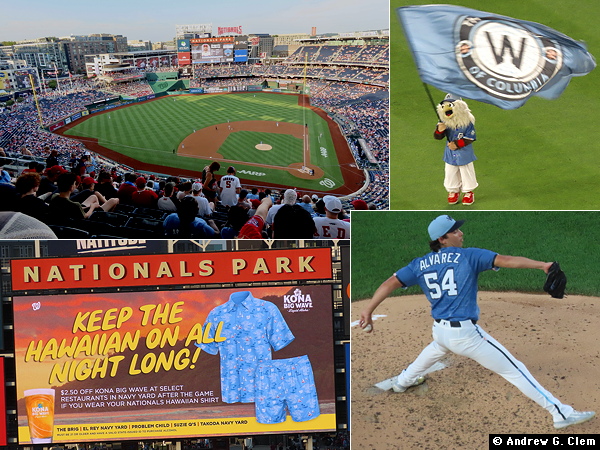
Scenes from Nationals Park on August 8, which was being celebrated as "Hawaiian Night." Hawaii (which some people spell with an apostrophe: "Hawai'i"), was actually admitted as the 50th state on August 21, 1960. [Nats' Starting pitcher Andrew Alvarez did very well but unfortunately was not credited with the win.]
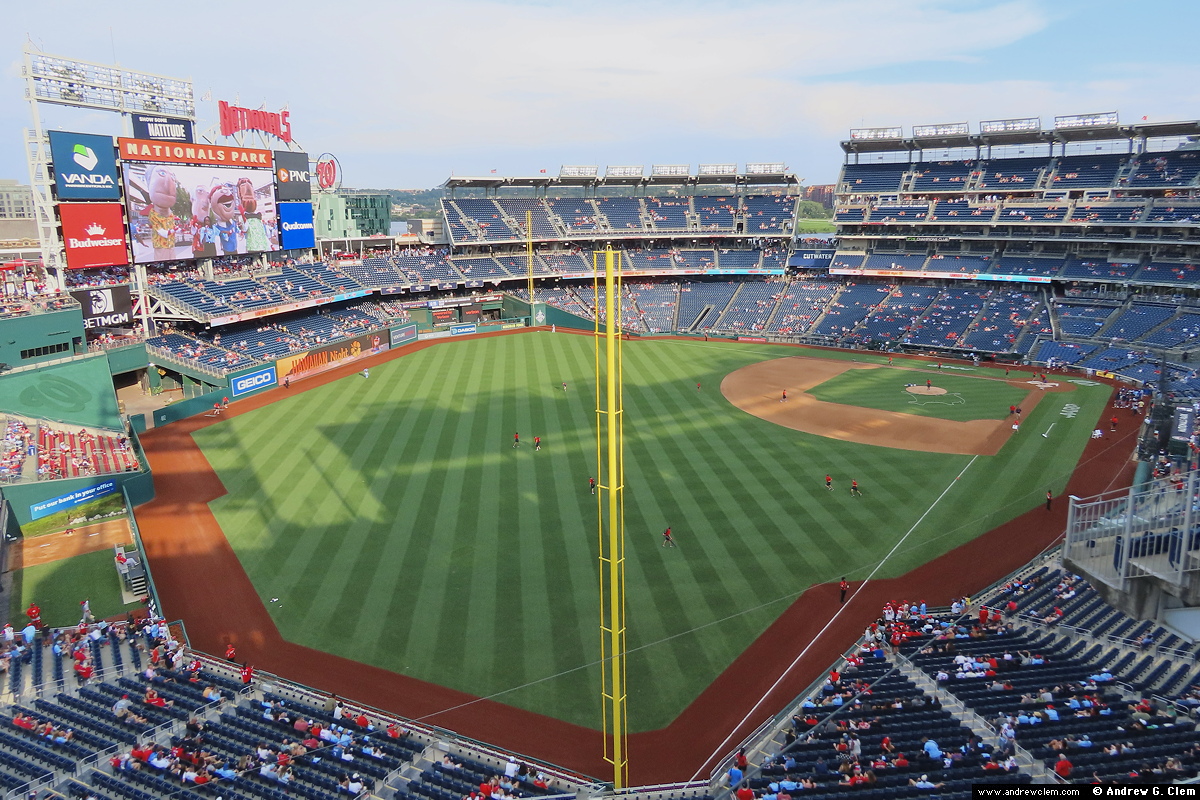
Nationals Park from the northwest corner as players warmed up for the game.
The Nats perhaps had good reason to be a bit edgy: the last time they played the Reds (in Cincinnati on May 14), they lost 15-1! As the game got underway, starting pitcher Andrew Alvarez gave up two singles and a walk in the first two innings, but he kept his cool and no damage was done. The Reds' starting pitcher Chase Burns retired the first six batters he faced, showing that he is indeed of All-Star quality. (He had an astounding 13-1 record before this game.) The Nats got their first hit in the 3rd inning, a leadoff single by Jose Tena. Two batters later, C.J. Abrams doubled and Tena went to third. Then, on an 0-2 count, newly acquired Abimelec Ortiz singled to left field, bringing in both baserunners to score. That guy is having a heck of a debut with the Nationals. I got a good look at his wide face, and it occurred to me that he might be a relative of the Red Sox' retired stocky superstar David Ortiz. Not so, evidently. David is from the Dominican Republic, while Abimelec is from Puerto Rico.
No Reds batter reached base in the 3rd, 4th, or 5th innings, and Alvarez seemed to be in complete control. But right after Sal Stewart singled in the 6th inning, manager Blake Butera replaced Alvarez with Max Kranick. Dane Meyers popped out, but then Eugenio Suarez hit a home run into the left field (visitors') bullpen, and the game was tied. Argh! There went Alvarez's hope to get credit as the winning pitcher. Instantly fans (including me) groaned about the Nationals' woeful bullpen, and many of us wondered aloud why Alvarez was replaced so suddenly. His pitch count was only 73, after all. But it really didn't matter because Dylan Crews ignited a rally with a leadoff double in the bottom of the 6th, followed by an RBI single by Daylen Lile, a double by Keibert Ruiz, and a walk issued to Nasim Nuñez to load the bases. That was enough for Reds manager Terry Francona (yes, the former Red Sox boss!), and the night was over for Chase Burns.
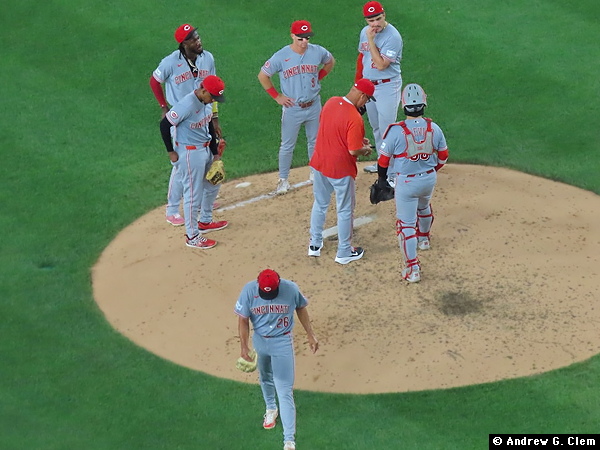
In the 6th inning, Reds manager Terry Francona took the ball from a dejected Chase Burns, while his team mates confer on the mound.
In response to the pitching change, Blake Butera had Andres Chaparro pinch hit for designated hitter Jose Tena with just 1 out. Frankly, I have regarded Chaparro with disdain for much of this season, as he often exhibits poor plate discipline and chokes in clutch situations, but not this time! On a 1-1 count he smashed a bases-loaded double down the left field line, probably the decisive play of the game.
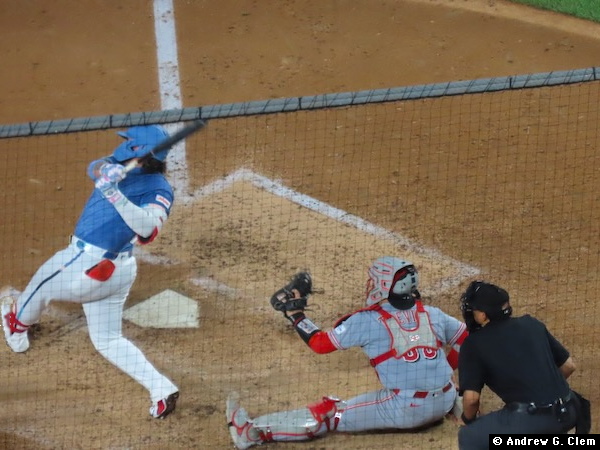
Fans reacted with whooping exhilaration when Andres Chaparro hit a clutch bases-loaded double in the 6th inning, BUT ...
For some reason, Nasim Nuñez tried to score all the way from first base on that play, and was easily thrown out at home. As one of the TV announcers said of the Nats' 3rd-base coach, "not the greatest of sends by Victor Estevez..." [Nuñez leads the majors in stolen bases with 40, which probably influenced the coach's decision.] But the next batter, Jacob Young hit a single to bring home Chaparro, who had reached 3rd base on a wild pitch. So, the Nats had a 6-2 lead after all. With their often-shaky bullpen, every run counts!
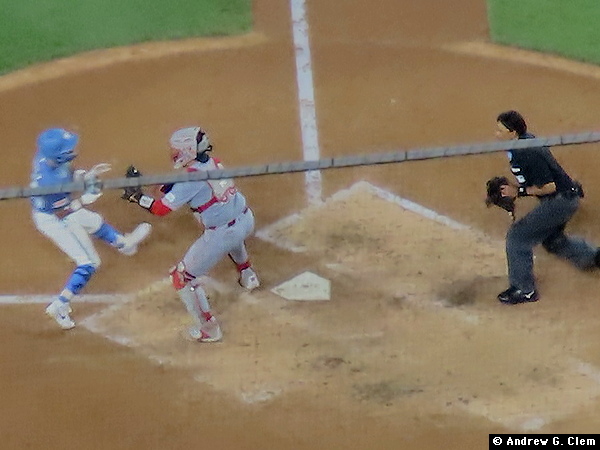
... Nasim Nuñez was out by a mile at home plate after shortstop Elly de la Cruz relayed the ball from left field with a blazing-fast strike to the Reds catcher Jose Trevino.
In the 7th inning, Yovanny Cruz (recently acquired from the Yankees in the big trade for Luis Garcia) took the mound and got into a bit of a jam, with runners on 1st and 3rd, but struck out Elly de la Cruz. Nats reliever Clayton Beeter got through the 8th inning just fine, just giving up a walk. In the bottom of the 8th, Chaparro hit an RBI single (the Reds' challenge of the call at first base was denied), and two batters later C.J. Abrams batted him in with a single to center field. Fans in Nationals Park (which was over 3/4 full, with 32,602 in attendance) were elated beyond measure, celebrating a big lead after so many recent tough losses. In the top of the 9th Tom Cosgrove struck out the first two batters and induced a fly ball out from Ivan Johnson to end the game on a triumphant note. Final score: Nats 8, Reds 2.
* I have to say, it was one of the most enjoyable Nats games I have seen in a long time. My niece Shary was very happy to be given an official certificate for her first game at Nationals Park! One noteworthy tidbit about that game: the only change in the lineup was for the designated hitter. All 8 position players put in a full 9 innings! Since the Nationals' roster has recently gone through some upheaval thanks in part to the trades over the past couple weeks, I thought it would help to show some of the new Nats' faces. This composite image includes some veterans as well as recent arrivals:
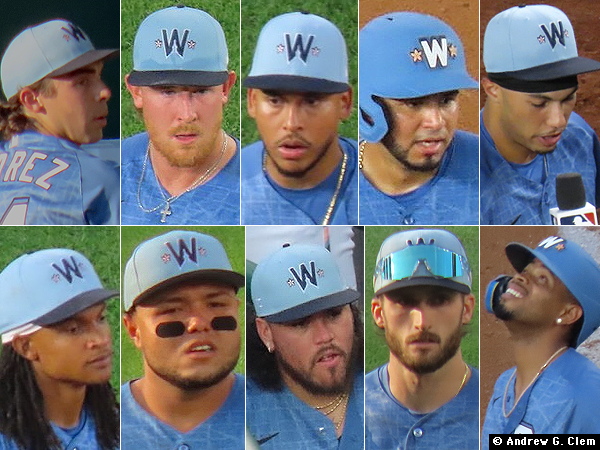
CLOCKWISE FROM TOP LEFT: Andrew Alvarez, Clayton Beeter, Jorbit Vivas, Keibert Ruiz, Daylen Lile (who was interviewed by Alexa Datt near the dugout after the game), Jose Tena, Dylan Crews, Andres Chaparro, wide-faced Abimelec Ortiz, and C.J. Abrams.
In the game on Sunday, which was broadcast [carried] by NBC's streaming service "Peacock," the Reds took a 1-0 lead in the 2nd inning, but things quickly swung in the home team's favor. Three Nats players singled (including an RBI by Keibert Ruiz), and then Jacob Young gave his team the lead with a sacrifice fly. In the 3rd inning, Abimelec Ortiz hit a solo homer. Brad Lord (just back from the injured list) was replaced by Will Dion (part of the trade with the Cleveland Guardians for Foster Griffin), and did just fine for three innings, only giving up one hit. He was replaced by Trevor Williams (who missed the first four months of this year due to injury), who got through the 8th inning without allowing any runs. Then former Yankee Jake Bird took the mound in the top of the 9th, pitching for the first time as a National. (He had been on the IL at the time of the trade.) He did just fine in his debut with Washington: a 1-2-3 inning that gave the Nats an easy 7-1 win, and their first series sweep at home this year! (The swept the Brewers in Milwaukee in April.)
So, the Nationals are back to within two games of .500 (59-61), and have at least regained some of their confidence as the final quarter of the 2026 season is about to get underway. [Since none of them homered during the weekend, the team lead is home runs is down to just 4 (171 vs. 167) over the #2-ranked New York Yankees. The longer that James Wood remains on the IL, the more the team's dominance in a wide variety of offensive statistical categories become jeopardized.] Today the Nats have their first day of rest since July 23: that's 17 straight days with a game! Tomorrow the Chicago Cubs will arrive in Washington for a 3-game series, and then the Nats head to the Queens to play the Mets, [who just beat the Braves in Atlanta].
On a side note, the L.A. Dodgers came within inches of losing their 8th straight game in Phoenix on Saturday, as the Diamondbacks tied the game 1-1 with back-to-back triples to start the bottom of the 9th inning. But then they blew an easy opportunity to score the game-winning run, and ended up losing after 10 innings. Even so, the Dodgers lost again on Sunday.
To see previous blog entries, go to the Baseball archives page.
 Can't see the whole postseason scores table? You're probably in mobile view mode.
Go back to the top and click the link to return to desktop view mode.
Postseason scores, 2026
Major League Baseball championship series, 2026
World Champions: TBA
Wild Card series
Sept. 29 - Oct. 1 |
Divisional series
Oct. 3 - 10 |
League Championship series
Oct. 11 - 20 |
World Series
Oct. 23 - 31 |
| . |
. |
. |
. |
. |
. |
. |
. |
. |
. |
. |
. |
. |
. |
. |
. |
. |
. |
. |
. |
. |
. |
. |
. |
. |
. |
. |
| NL-wc (6) |
Philadelphia Phillies (.543) |
3 |
4 |
|
| NL-E (3) |
Atlanta Braves (.580) |
5 |
3 |
|
|
|
|
|
|
|
|
|
|
|
| NL-W (2) |
|
Los Angeles Dodgers (.617) |
|
|
|
|
|
|
|
| |
|
|
|
|
|
|
|
|
|
| |
|
|
|
|
|
|
|
|
|
| NL-wc (5) |
Chicago Cubs (.549) |
0 |
1 |
X |
| NL-wc (4) |
San Diego Padres (.562) |
8 |
4 |
X |
|
|
San Diego Padres |
|
|
|
|
|
|
|
| NL-C (1) |
|
Milwaukee Brewers (.636) |
|
|
|
|
|
|
|
| |
|
|
|
|
|
|
|
|
| |
|
|
|
|
|
|
|
|
| AL-wc (6) |
Chicago White Sox (.519) |
6 |
7 |
X |
| AL-W (3) |
Houston Astros (.500) |
3 |
3 |
X |
|
|
Chicago White Sox |
|
|
|
|
|
|
|
| AL-C (2) |
|
Cleveland Guardians (.525) |
|
|
|
|
|
|
|
| . |
|
|
|
|
|
|
|
|
|
| |
|
|
|
|
|
|
|
|
|
| AL-wc (5) |
Boston Red Sox (.537) |
0 |
9 |
X |
| AL-wc (4) |
New York Yankees (.578) |
9 |
2 |
X |
|
|
New York Yankees |
|
|
|
|
|
|
Extra-inning game (underlined): |
X |
| AL-E (1) |
|
Tampa Bay Rays (.605) |
|
|
|
|
|
|
Win by visiting team (shaded): |
X |
See explanatory notes at bottom.
COMPARE THIS TABLE TO: Postseason scores since 2002
Explanatory notes
(Regular season winning percentages in parentheses.) Boldfaced scores indicate the winning team. Underlined scores denote extra-inning games. Olive-shaded score boxes denote games won by the VISITING team. Higher-seeded teams (those with the initial home field advantage) are shown on the BOTTOM side in each matchup. However, beginning with 2012, each league has TWO wild card teams, competing in a one-game "play-in," and whichever of those two teams that wins in each league is displayed below (after the outcome is known), so as to properly align with the subsequent divisional series scores. Beginning in 2003 and continuing through 2016, the league that won the All Star Game got the initial home field advantage in the World Series; prior to 2003, initial home field advantage in the World Series alternated from year to year. Except for 2002 (the infamous tie), the American League won the All Star Game every year between 1997 and 2009. Beginning in 2017, home field advantage in the World Series goes to the team with the higher regular season winning percentage.
Introduction to stadium diagrams
An interactive graphic and explanation formerly shown here; moved to a new page.
Stadium chronology
(An interactive graphic table (by decade) formerly shown here; moved to a new page.
Sources
A list of books and other publications formerly shown here; moved to a new page.
Terms of use
HTML 5!


Number of visitors to this page since June 13, 2004: 
Copyright © Andrew G. Clem. All rights reserved. Photographs taken by other persons (as indicated by credits) are used with permission. Use of this site indicates your agreement to abide by the Terms of Use.


