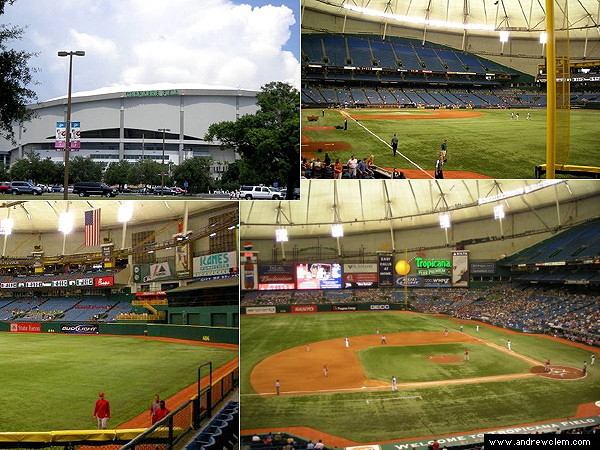
Photos below!
BEEN THERE (NOT!): I saw the unmistakeable white dome from a distance of 40+ miles and an altitude of 40,000+ feet in February 2005.
WORLD SERIES: 2008 (lost to the Phillies) NCAA basketball Final Four: 1999 ARTIFICIAL TURF: ever since 1990
This was probably the most egregious example of a baseball stadium built "on speculation," and hopefully it will be the last. The original idea was to give the Chicago White Sox franchise a juicy package of incentives to relocate to sunny Florida, but Illinois politicians secured a financing deal to build a replacement for Comiskey Park (the 1991 structure which is now called "Rate Field") just in the nick of time. Left out in the (figurative) cold, Tampa Bay area promoters then turned their attention to other restless teams, but those deals fell through as well. Tampa Bay missed out on the 1993 expansion round, but finally got lucky when MLB bestowed the franchise rights upon them in 1996. None of the other stadiums built on speculation had to wait as long as eight years before a major league team moved in.
This is apparently the only tilted dome stadium, which looks strange from the outside but makes sense for baseball, where most of the seats are positioned behind home plate. (Some folks in St. Petersburg deride this white dome as the "diaper pail.") The tilted dome also reduces the total inside volume, cutting air conditioning costs. Like the Georgia Dome, the roof is supported by a complex system of arches and cables, with four support rings upon which lights are installed, with catwalks. Under the current ground rules, the two inner catwalks are in play, while any ball hitting the two outer catwalks in fair territory are home runs. (In September 2008, Alex Rodriguez hit a massive home run that struck the catwalk behind the left field foul pole.) The apex of the roof is 225 feet above the field, directly above a point just in front of second base. In nearly all other "doughnut" stadiums, in contrast, the center point was at least 20 feet beyond second base. This is because those stadiums were explicitly designed to accommodate football games, with a balance in the number of seats all the way around, but (until recently -- see below!) there was never any thought of that in this cozy little dome. The overall design is similar to the Kingdome in terms of how a rectangular playing field is fitted into a circular structure, and similar to Kauffman Stadium in terms of how the upper deck tapers to a point near each of the foul poles. One minor design flaw is the orientation of the seats adjacent to the bullpens near the left and right corners, facing toward center field. Those seats are also too far from the field. In my opinion, those rows of seats should have been made to curve toward the infield beginning at a point close to the infield. At any rate, it was better suited for baseball than Dolphin (now Hard Rock) Stadium, where the Florida Marlins played for 19 years.
 Under the original (1990) design, the outfield dimensions were perfectly symmetrical: 340 feet to each corner, 385 feet to the power alleys, and 410 to center field. By the time Tampa Bay was awarded a major league franchise in 1996, baseball stadium architecture had been revolutionized, and symmetrical domes were hopelessly out of style. So, they went to work trying to patch things up to conform to prevailing trends, putting angled fences in the corners, and turning the center field wall a few degrees clockwise. However, the resulting trivial asymmetry was all rather arbitrary and a bit contrived. The distance from home plate to the backstop is only 50 feet, but there is a lot of foul territory down the lines, where fans can dine at tabletops in special areas next to the bullpens.
A major part of the $85 million renovations prior to 1998 was the fancy cash-siphoning shopping mall through which many patrons enter the stadium. Open year round, it is known as "Center Field Street," and its signature feature is an eight-story-high rotunda entrance modeled after the one at Ebbets Field. Another addition was "The Beach" -- a small elevated deck with low-price seats overlooking left field. Behind the center field wall is the "Batter's Eye Restaurant" that features specially tinted windows. All those creature comforts are well and good, but no fancy bells or whistles or climate controls can hide the fact that indoor baseball is not real baseball. (One might question whether baseball even belongs in Florida during the summer, given the intense heat, humidity, and frequent tropical storms.) In a survey of major league players published in the July 7, 2003 issue of Sports Illustrated, Tropicana Field was rated as the fourth least favorite of all ballparks. There is one saving grace, however: It was judged to have the nicest visting team locker room.
Tropicana Field is the first stadium with artificial turf to have an all-dirt infield playing area since Busch Stadium in 1976. In 2000 a new surface (called "FieldTurf") was installed, giving Tropicana "Field" a more natural color and texture. It's like the "NeXturf" installed at Veterans Stadium in 2001. In 2007 (or thereabouts) a big new video display / billboard was installed in back of right field, causing a net loss of a few hundred seats. Prior to the 2014 season, they added a new walkway (called "Rays 360") around the entire lower deck, allowing fans to wander around without losing sight of action on the field. This entailed the removal of several hundred additional seats, as well as opening the restaurant in center field.
For the first ten years, the Devil Rays spent most of the time at or near the bottom of the American League East Division. Frustration on the playing field was reflected in low sales at the ticket booth. In 2002 they became the first team to have lost 100 or more games in two consecutive years since the Blue Jays did so in 1977-1979. Average attendance in 2002 was about 13,000, the third lowest in the major leagues. In 2006 the owners spent several million dollars sprucing up the stadium, adding a unique feature in the gap on the right side of the center field restaurant: a large aquarium tank containing several live rays! (They are the relatively small and placid "Cow-Nosed rays," however, not exactly the fearsome undersea beasts one usually thinks about.) Then, in 2008 the team was renamed the "Rays," rather than "Devil Rays," and the result was immediate! They showed unexpected slugging power, led by veteran Carl Crawford, Carlos Peña, and rookie Evan Longoria, as well as solid pitching, and climbed to the top of their division. Against all odds, they hung on to first place through the rest of the season, and won the American League pennant for the first time. They lost to the Phillies four games to one in the World Series, however. The Rays have remained a postseason-contending team in most years, but attendance still lags. That is why are often mentioned as one of the "at risk" franchises, and relocation or "contraction" is not entirely out of the question.
For two three-game series in May 2007 and April 2008, the Rays played "home" games at Champion Stadium (now called Disney's "Wide World of Sports") in Orlando, Florida. This was aimed at broadening the Rays' fan base in Florida, though some suspected subtle pressure on local governments to get a new baseball stadium built. See the Anomalous stadiums page. After repeated efforts to get a new stadium built either in St. Petersburg or across the bay in Tampa, the Rays' owners resigned themselves to completing the full 30-year lease term in Tropicana Field, committing to improving the existing stadium. In January 2019 they announced that the entire upper deck would be closed, striving to create a more "intimate" baseball experience. This reduced the seating capacity from 42,735 to 25,025. In my opinion, they should consider at least opening the first eight or so rows of the upper deck.
On October 9, 2024 Hurricane Milton wrecked the roof of Tropicana Field and caused extensive damage inside, which could not handle all the torrential rain that fell. As a result, the Rays were obliged to play all of their 2025 games at George M. Steinbrenner Field, near Raymond James Stadium on the northwest side of Tampa. After repairs and some improvements were completed, the Rays returned to their original home in 2026, officially reopening it on April 6.
One month later, in May 2026, a "Memorandum of Understanding" was reached with the Rays, Hillsborough County, the City of Tampa, and others under which a new stadium would be built on the east side of the Hillsborough Community College campus (just south of George M. Steinbrenner, coincidentally), and by August the agreement was essentially confirmed by all the interested parties. It is hoped that construction will be completed in time for the 2029 season.
This is the only major league baseball stadium ever to have served as a hockey arena on a regular basis. While the NHL Tampa Bay Lightning played here (1993-1996), it was named the "ThunderDome." The structure was renamed "Tropicana Field" in October 1996 under a contract with the Tropicana-Dole Corporation, a key part of the financial arrangements needed to upgrade the stadium prior to the inaugural 1998 season. The NCAA basketball championship "Final Four" games were played here in 1999, and the Arena Football League Tampa Bay Storm played here as well. In December 2008, the first annual "St. Petersburg Bowl" (later called the "Beef 'O' Brady's Bowl") football game was played there as well. The final such bowl game was in December 2017.
SOURCES: Lowry (2006); Pastier (2007); USA Today / Fodor's (1996), Zimbalist (1992)
| The Clem Criteria: | |||||
|---|---|---|---|---|---|
| Field asymmetry |
Architectural design |
Seat proximity |
Location * | Aesthetics | Overall |
| 3 | 5 | 4 | 5 | 3 | 4.0 |
* See the Stadium locations page.
Visit St. Petersburg - Tampa!
Tropicana Field is located about 1.5 miles from downtown St. Petersburg, too far for most people to walk. Fans who decide to visit the downtown area before or after a game may be interested to see historic Al Lang Stadium, where the St. Louis Cardinals used to host spring training games. Nearby toward the south is the Salvador Dali Museum, dedicated to the artistic legacy of the famed Spanish surrealist painter. Along the Gulf of Mexico (!) shoreline are several public beaches and a few island wildlife preserves. Since the Tampa Bay Rays recently reached an agreement under which a new stadium will be built near Raymond James Stadium on the northwest side of Tampa, the days of major league baseball in St. Petersburg are numbered.