


July 9, 2026 [LINK / comment]
Yet another road trip to the Midwest!?
As noted in my June 26 blog post about baseball, I spent the first half of last month on an overland journey to the Midwest and back. It was actually the third time over the past twelve months that I have made such a trip, with similar destinations but significant variations in the routes to and from. (Family obligations were a big factor behind these trips.) On this trip I made three notable "touristy" stops on the westward leg, three major day trips (oriented around birding) while in South Dakota, and five notable (if not lengthy) stops on my way back home in the east.
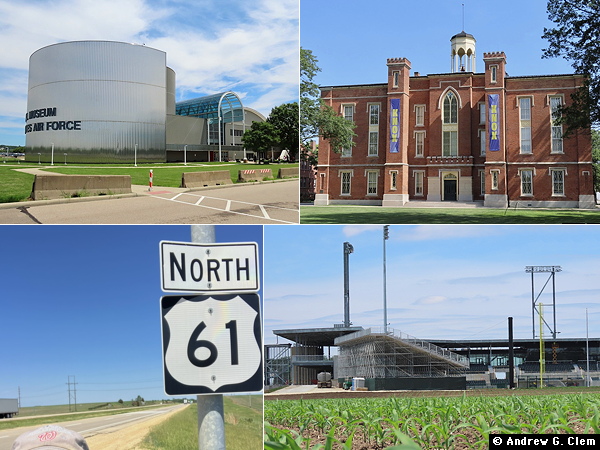
CLOCKWISE FROM TOP LEFT: U.S. Air Force Museum, Dayton, Ohio (May 31); Knox College, Galesburg, Illinois (June 1); the new stadium near the Field of Dreams movie site northeast of Dyersville, Iowa (June 1); and Highway 61 (Revisited?) sign in eastern Iowa (June 1).
On May 31, I fulfilled a long-deferred goal when I spent a couple hours at the U.S. Air Force Museum in Dayton, Ohio. It is located next to Wright-Patterson Air Force Base, and in fact used to be part of it. Four of the big hangars in which historical aircraft are displayed were formerly used operationally by the Air Force. Being time-constrained, I only visited the section devoted to World Wars I and II (a highlight being the "Memphis Belle" B-17 bomber), leaving for a future date a visit to the Cold War and recent sections, including missiles. I then drove straight across Indiana, catching a glimpse of Lucas Oil Stadium, home of the NFL Colts, and got through most of Illinois before dusk.
The next day, June 1, I started by visiting the campus of Knox College in Galesburg, Illinois. Besides being a fine academic institution, it has historical significance for being the site of one of the Lincoln-Douglas debates in 1858. I had caught a glimpse of the south edge of the campus previously while traveling on Amtrak trains. Then I drove around Galesburg, which seems like a prosperous, friendly community. While downtown, I noticed a sign for the "Ronald Reagan Trail," which I assume takes a person to various historical sites where the 40th president spent his formative years. I then crossed the Mississippi River east of the Quad Cities and then proceeded north on U.S. Highway 61, which was made famous by Bob Dylan in his 1965 album with that name. As noted in my June 26 blog post, I paid a visit the Field of Dreams movie site near Dyersville, Iowa. (They were putting the finishing touches on a new stadium where an MLB game will be played in August!) Then I resumed my westward course along Highway 20, and arrived in Sioux Falls, South Dakota late in the day.
Out and about in South Dakota
During my ten or so days in South Dakota, I made several day trips oriented around birding, taking advantage of the fact that it was still breeding season. On June 6 my brother John and I drove all the way up to Watertown in an ambitious birding venture, passing many lakes along the way. Northeastern South Dakota is full of lakes, and it's chock full of recreational tourists during the summer months.
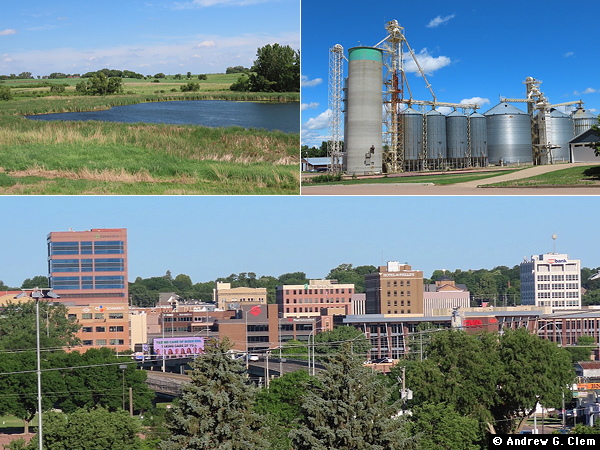
CLOCKWISE FROM TOP LEFT: Dewey Gevik Nature Area (June 9); grain elevators in Parker (June 11); skyline of Sioux Falls from the east. (June 12)
My next big trip was June 9, when I went to Wall Lake and nearby Dewey Gevik Nature Area, located about 12 miles west of Sioux Falls. There were lots of folks on boats and on the beach. While there I saw four F-16 fighter jets from the South Dakota Air National Guard flying overhead.
My last full day in South Dakota (June 11) I took a meandering drive during the morning and early afternoon to see various towns such as Parker and Marion. I decided to photograph the grain elevators in each town that I passed, since agriculture is the biggest business in the state. In the late afternoon my brothers and I got together for a delicious barbecue dinner in the town of Freeman. On the way back to Sioux Falls, I finally got a good look at several Ring-necked Pheasants, as will be described in more detail in a future bird-oriented blog post. It was a fitting send-off, since they are the official state birds of South Dakota.
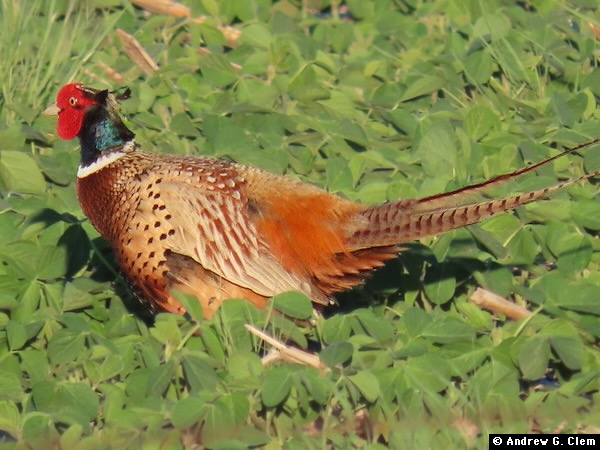
Ring-necked Pheasant (male), north of Freeman, SD. (June 11)
While on a birding walk west of the Sioux Falls airport on June 8, I spotted three different small mammals in the open fields. The 13-lined Ground Squirrels are fairly common, and most people just call them "gophers." I was lucky to spot a Richardson's Ground Squirrel. That species is plain in appearance, looking like tiny groundhogs. Finally, I was very lucky to see several White-Tailed Jackrabbits foraging in the distance. I learned that they are reclusive by nature, but one is more likely to see them during breeding season.
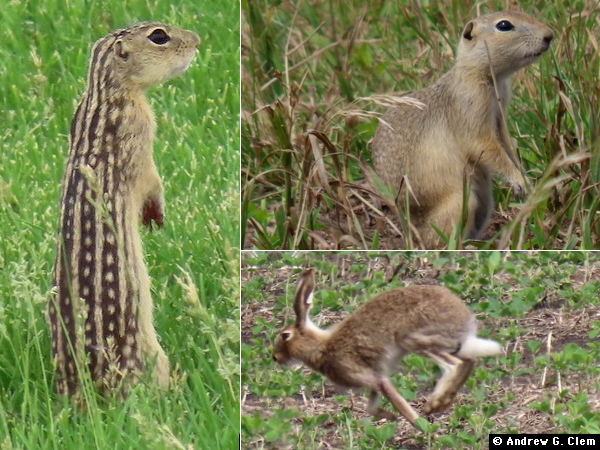
LEFT: 13-lined Ground Squirrel; TOP RIGHT: Richardson's Ground Squirrel; White-Tailed Jackrabbit. (June 8, west of Sioux Falls airport)
Return trip: east by northeast!
Since I had already driven across the Midwest to or from Virginia five times since the previous August, I decided to something different for my return trip to Virginia. So, instead of heading east on the morning of June 12, I went northeast toward the Twin Cities of Minneapolis and St. Paul. Gradually the terrain changed, with more and more trees. I was curious about the social situation in the wake of the violent clashes with ICE agents during the winter, so I drove for a while along Nicollet Avenue in southern Minneapolis. One thing I learned is that there are a lot of people from Muslim countries there. Another thing is that the McDonald's restaurant south of downtown did not have restrooms available to the public, presumably for fear of crime. Very aggravating! Once I reached downtown, I parked for a while so that I could get some photos of Target Field, home of the Minnesota Twins. This time I passed the western and southwestern sides, whereas before (2010), I had seen it from the north and eastern sides. After some awkward navigation along congested streets, I made it to U.S. Bank Stadium, home of the Minnesota Vikings. Then I drove to St. Paul, where I got some great photos of the Minnesota State Capitol. (My previous visit there many years ago was during the winter, and the photo I took was lousy.) Then I drove straight east through Wisconsin for a few hours. I was surprised and annoyed to encounter major traffic delays in the middle of nowhere, and I really don't know what the problem was. There were more pine trees the farther east that I went, but no special nature areas that might have been worth visiting. I spent the night about an hour west of Green Bay.
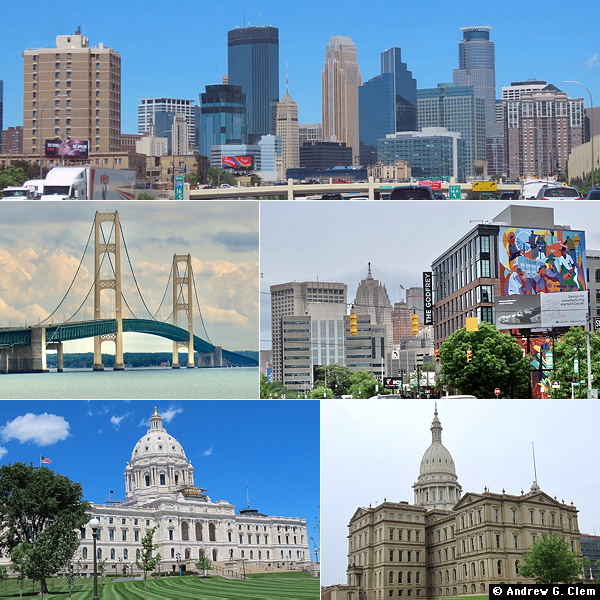
TOP: Minneapolis (June 12); MIDDLE: Mackinac Bridge (LEFT, June 13) and Detroit (RIGHT, June 14); BOTTOM: Minnesota State Capitol (LEFT, in St. Paul, June 12) and Michigan State Capitol (RIGHT, in Lansing, June 14).
On Saturday June 13 I had two objectives: visiting Lambeau Field (home of the Green Bay Packers) for the very first time and stopping to look for birds that breed in northern latitudes. I struck out as far as birds, but got some very nice photos of Lambeau Field in the morning sun. I was mildly surprised that the stadium is adjacent to a residential neighborhood, and that most of the parking area consists of nothing but grassy vacant lots. (Most of the Packers' fans "commute" to the games from Milwauakee via bus or train.) I drove northeast toward the town of Marinette, which features an impressive gleaming white county court house. Then I crossed the river into Michigan, and a nice lady at the visitor center tried to be helpful as far as identifying locations to look for birds. I ended up spending too much time stopping at various places along the way, further delaying my very ambitious itinerary. During my cross-continent road trip in 1987 I had crossed the Upper Peninsula (U.P.)* of Michigan from east (Sault St. Marie) to the west, parallel to Lake Superior. This time I crossed along the southern, Lake Michigan side. In the mid-afternoon I crossed the famous Mackinac Bridge (built in 1958) for the very first time, and I spent the night near the town of Grayling, where I was delighted to see "Kirtland Community College," named for a rare bird that I was pursuing.
* People who reside in the U.P. are called "Yoopers," and I saw a sign for a "Yooper Winery."
Sunday June 14 was a big day, but it was already getting cloudy in the morning, a rather ominous sign as we shall see. I spent a couple hours in the morning searching for the seldom-seen Kirtland's Warbler, as will be described in a future blog post. (Spoiler alert: I succeeded in my quest!) The land in north-central Michigan is covered with pine forests, and it seems they have reached a good balance between commercial use of the timber resources and the wildlife conservation. I saw timber operations owned by Weyerhaeuser and Arauco near Grayling. The Weyerhaeuser Corporation advertises itself as "the tree-growing company," and that seems to be an accurate description from what I could tell. Anyway, I got back on the highway and headed south, as it began to rain lightly. By the time I got to Lansing, where I paid a visit to the state capitol building, the rain was getting steadier. On the radio were warnings about floods in the Detroit area, which was my next destination. Indeed the rain became a real problem, causing the traffic to slow down as I entered the suburbs of Detroit, and I saw some accumulated water in a couple places. I visited four separate stadium sites in Detroit: Hamtramck Stadium, Comerica Park, Ford Field, and "The Corner Ballpark," where Tiger Stadium once stood. As in the Twin Cities, navigating urban streets proved to be a big challenge, and I wasted some time making wrong turns. Because of the rain, there wasn't much point to taking photos of the downtown skyline, as I had hoped to do.
Anyway, I got back on the road heading to Toledo, but as I approached Cleveland there were more reports of severe thunderstorms, so I bypassed that city entirely. It was already late afternoon, and my hopes of taking photos in Pittsburgh quickly dwindled as the rain got worse again. To save money on the very expensive Pennsylvania Turnpike, I headed south toward Morgantown, West Virginia and spent the night in that area. The next day I drove along I-68 in western Maryland, picked up Jacqueline at Dulles Airport, and we headed home together -- quite exhausted!
To see some of the above photos in larger size, see the Chronological Photos, 2026 web gallery page, which has been thoroughly updated, but probably needs a bit more tweaking.