
PRESIDENT: Jose Antonio Kast (Mar. 2026 - 2030)
POPULATION: 18.7 million (2024 est.)
KEY EXPORTS: Copper, fruit, wine
PRESIDENT: Jose Antonio Kast (Mar. 2026 - 2030)
POPULATION: 18.7 million (2024 est.)
KEY EXPORTS: Copper, fruit, wine

Home page >> Latin America Intro page >> Chile ("under reconstruction")Updated:
| Decade / year | Key events. |
|---|---|
| 1800s (early): | Independence declared in 1810, won in 1818. |
| 1800s (mid): | Victorious war against Peru-Bolivia Confederation, 1836-1839. |
| 1800s (late): | Victory against Peru and Bolivia in War of the Pacific (1879-1883), taking Bolivia's mineral-rich coastlands. |
| 1900s: | Aristocratic republic was consolidated. |
| 1910s: | |
| 1920s: | Military coups. |
| 1930s: | Military coups. |
| 1940s: | |
| 1950s: | Democracy became consolidated. |
| 1960s: | . |
| 1970s: | Salvador Allende (radical Socialist) was elected president in 1970 but was ousted in a military coup in 1973. Augusto Pinochet becomes dictator. |
| 1980s: | Economic growth under Pinochet government, which allows elections in 1989. |
| 1990s: | Gradual transition to democracy. |
| Oct. 1998 | After resigning as armed forces commander, Augusto Pinochet goes to Britain for medical treatment, but was placed under house arrest pending extradition to Spain. |
| Dec. 1999 | Moderate socialist Ricardo Lagos edged Joaquin Lavin ("Chicago boy" of Pinochet) in first round election. |
| Jan. 2000 | Ricardo Lagos defeated Joaquin Lavin in second round election. |
| Mar. 2000 | Augusto Pinochet was allowed to return to Chile, on grounds of poor health. Congress passes const. amendment to protect him. |
| Sept. 2000 | Chilean Supreme Court lifts Augusto Pinochet's immunity. CIA report acknowledges ties to Manuel Contreras, ex-head of secret police. |
| July 2001 | Chile announces purchase of 12 F-16 jets from the U.S., angering Peru. Appeals court rules Pinochet is mentally unfit to stand trial. |
| July 2002 | Pinochet resigns his lifetime seat in Chilean Senate. |
| Aug. 2002 | Strike by transportation workers shut down Santiago bus system. |
| Sept. 2002 | Survey: 63% of Chileans oppose giving a strip of land to Bolivia to facilitate natural gas exports. |
| Oct. 2002 | Court grants immunity to ex-air force officer accused of helping Pinochet's "dirty war," sparking protests. |
| Nov. 2002 | Officials from 160 countries met in Santiago to strengthen Convention on International Trade in Endangered Species (CITES). |
| Nov. 2002 | Five left-center members of Congress were removed for bribery, leaving Pres. Lagos with a thin majority. Tax and spending hikes discouraged new private investment. |
| Dec. 2002 | U.S. and Chile sign bilateral free trade agreement. |
| Jan. 2003 | Chile is chosen for U.N. Security Council. For. Min. Maria Soledad Alvear said Chile will maintain a restrained, indep. position, even though relations with U.S. are close. |
| Jan. 2003 | Public Works minister Carlos Cruz resigned, in yet another corruption scandal. Pres. Lagos still popular. |
| Feb. 2003 | Three more Socialist deputies were arrested for bribery related to vehicle inspections. |
| Mar. 2003 | Pres. Lagos proposed that Iraq be given three more weeks to comply with U.N. resolution. British newspaper: Chilean diplomatic telephones tapped by U.S. |
| Apr. 2003 | Pres. Carlos Massad resigned from Chilean Central Bank, for bribery and insider trading. Legislators are accused of influence peddling. |
| May 2003 | Students and public employees protest lack of funding. Chile's amb. to U.N., Juan Gabriel Valdes, was reassigned after opposing U.S. war policy, contrary to instructions. |
| June 2003 | After a delay caused by frictions over war in Iraq, Chile and U.S. signed free trade treaty. |
| May 2004 | Pres. Lagos signs into law the right to divorce, which Catholic Church sharply opposed. Manuel Contreras is sentenced to 15 years over disappearance of journalist in 1974. |
| July 2004 | U.S. Senate reports that Riggs Bank helped Augusto Pinochet hide millions of dollars while he was under house arrest in London. |
| Aug. 2004 | Chile's Supreme Court stripped immunity from Augusto Pinochet, in a 9-8 decision. |
| Nov. 2004 | Pres. Bush attends APEC summit in Chile, warns N. Korea on nukes. 25,000+ protest: Molotov cocktails and signs calling him a "terrorist." |
| Dec. 2004 | Pinochet was charged with murdering and kidnapping opponents during 1970s, and is placed under house arrest. |
| July 2005 | Congress passes const. amend. that strips armed forces' privileges and restores president's right to dismiss military commanders. |
| May 2005 | Manuel Contreras blamed Pinochet for human rights abuses, personally ordering that Orlando Letelier be killed in 1976. |
| Nov. 2005 | Peru unilaterally changes maritime border, Pres. Lagos says Chile will exercise sovereign control over its waters. Pinochet is charged with tax evasion, etc. Ex-Pres. Fujimori arrives in Chile, but is arrested. |
| Dec. 2005 | Socialist Michelle Bachelet won 46% in first-round presidential election, and will face Sebastian Piñera on Jan. 15. Socialist Party gains a few seats in Senate and Ch. of Dep. |
| Jan. 2006 | Michelle Bachelet won the second-round presidential election. Copper mine workers in Chile strike for higher pay, hoping to take advantage of higher prices. |
| Mar. 2006 | Michelle Bachelet is inaugurated as Chile's first female president. |
| May 2006 | Alberto Fujimori was freed from jail pending Supreme Court decision on whether to extradite him to Peru. |
| June 2006 | After three days of violent protests by students, the government decided to give in to all of their demands, for more money, etc. |
| 2006 | Copper strike ends: Chilean mine workers compromise and accept a five percent raise. |
| Oct. 2006 | More student riots in Chile, over 100 arrested. |
| Dec. 2006 | Augusto Pinochet passed away a few days after suffering a heart attack. |
| Mar. 2007 | Chile recalls amb. to Venezuela because of indiscreet remarks in a TV interview about a private conversation he had with Pres. Bachelet last year. |
| Aug. 2007 | Chile withdrew its ambassador from Lima, angered by Peru's new official maritime map. |
| Nov. 2007 | Major earthquake in northern desert (7.7 magnitude), but few fatalities. |
| Jan. 2008 | Chilean amb. to Peru was recalled after Peru requested that the World Court resolve the maritime dispute. |
| Dec. 2008 | Chileans were outraged by YouTube video of remark by a general about Chileans being sent home in body bags; Pres. Garcia disavowed it. |
| 2009 |
SOURCE: Washington Post, CNN, BBC, etc.

Chile is the most elongated country in the world, hemmed in by the Andes Mountains, which form an almost impenetrable barrier along the border with Argentina. In the north is the Atacama Desert, one of the driest places on earth, with vast deposits of copper ore and nitrates. The central region is blessed by a mild Mediterranean climate that provides excellent growing conditions for grapes and apples, many of which are exported to the U.S. Further south one encounters a cooler, moister climate, much like the temperate rain forest of the Pacific Northwest. At the frigid southern tip of the continent, Chile controls the entire Straits of Magellan and half of the island of Tierra del Fuego. The capital, Santiago, is the only large city.
The two outstanding figures in early Chilean history were Bernardo O'Higgins, an Irish-born naval hero of independence (1818), and Diego Portales, a headstrong minister of finance who had visions of greatness for Chile. Chile has always had tense relations with its neighbors; in the War of the Pacific (1879-1883) it conquered vast amounts of land from Peru and Bolivia. Aside from a brief civil war in 1890, Chile has enjoyed much more stability than the rest of the continent. There were military coups and social turmoil in the 1920s and 1930s, and a socialist government ruled briefly in 1930. Strong social-democratic tradition, with Marxist minority; politics were very hard-fought but peaceful. In 1970 Socialist Salvador Allende became president, even though he only won a plurality of the vote. He pushed for a socialist revolution and nationalized U.S. copper mines, angering the Nixon administration. The CIA began covert intervention, disrupting the economy. As the result of strikes and his own economic policies, Chile was becoming quite chaotic, and in September 1973 the armed forces attacked the presidential palace and General Augusto Pinochet took control of the country. He launched a brutal "dirty war" murder of Orlando Letelier in Washington in 1976. Soon a group of conservative economists known as the "Chicago boys" launched a radical free market economic policy that caused great disruption and suffering at first eventually succeeded, though 1982 debt crisis almost ruined their plans. It set the stage for prolonged stable growth by the mid-1980s. Pinochet won referendums in 1978 and 1980, but stepped down after losing such a plebiscite in 1988. Elections in 1990 were won by Patricio Aylwin, a moderate. Socialist Ricardo Lagos won 1999 election.
Like Argentina and Uruguay, the people of Chile are predominantly of European descent. Many Basque people (a minority group with a distinctive language and culture from northern Spain) settled in Chile. German military advisers had a big impact on Chilean society in the early 20th century, and there are a number of towns where German is spoken; southern Chile resembles the mountainous regions of Bavaria and Austria. Some Chilean people identify with the Andean culture of Peru and Bolivia, as expressed in folk music and art, but most see themselves as Europeans. There are Indian communities in the southern part of the country, which did not come under control of the central government until late in the 19th century. Most Chileans today are fiercely proud of their country.
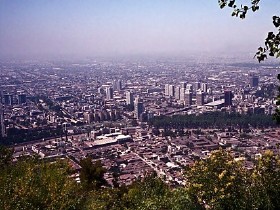
Santiago de Chile, the capital city of this pleasant Mediterranean corner of the Southern Hemisphere.
Top ~ Politics ~ Chronology
Chileans are torn between alternative paths toward integration with the outside world. During the 1970s Chile belonged to the Andean Group but left in 1978 in order to pursue a free-market capitalist economic model. Argentina and Brazil solicited Chile to join MERCOSUR during the 1990s, while some in the United States wanted to reward Chile's economic success by offering to let Chile join NAFTA. Chile is competing with Peru to build a pipeline to help Bolivia export its natural gas to North America, but resists Bolivia's call for territorial compensation for lands it lost to Chile in 1879. Most Chileans would like to see retribution for the crimes committed by Pinochet's military government, but many are thankful for the prosperity and stability he brought to the country. Unlike other countries in South America, Chile is unlikely to diverge much from its present course of moderate democratic capitalism. Since the return to democracy in 1990, Socialists have held the presidency except for 2010-2014, when free-market conservative Sebastian Piñera was president. In 2005, a series of constitutional reforms were adopted, most notably reducing the presidential term from six years to four.
National elections are held in November, with a runoff election in December if no candidate attains a majority of the vote. The 38 Senate seats (formerly 46) are elected for eight-year terms, staggered such that half (19) are elected every four years. The 120 seats in the Chamber of Deputies are elected for four-year terms. For both chambers there are two seats per district. Note that the left-leaning parties are grouped together in the "Concertación," and the right-leaning parties form the "Alliance for Chile."
| Party name | Comm- unist Party (PC) | Radical Social Demo- cratic Party (PRSD) | Party for Democracy (PPD) | Socialist (PS) |
Christian Democrat (PDC) | Indep- endent, etc. | Independent Democratic Union (UDI) |
National Renewal (RN) |
| Ch. of Dep. | . | S: 3 / CD: 7 | S: 3 / CD: 23 | S: 8 / CD: 15 | S: 6 / CD: 21 | S: 9 / CD: 34 | S: 8 / CD: 20 | |
| Ch. of Dep. | 6 | 6 | 15 | 16 | 21 | 12 | 29 | 15 |
| Sen. | . | . | 6 | 6 | 6 | 6 | 8 | 6 |
NOTE: Width of each column shows each party's approximate strength. Colors and position (left to right) represent approximate ideological leanings. Numbers show how many seats each party has in the Senate and the Chamber of Deputies. Minor parties are not shown.
Chilean Congress: senado.cl; camara.cl
Embassy of Chile in Washington, D.C.; also see embassy-worldwide.com
