
PRESIDENT: Keiko Fujimori (July 2026 - )
POPULATION: 32.2 million (0.9% ann. growth)
KEY EXPORTS: Copper, coca, etc.
PRESIDENT: Keiko Fujimori (July 2026 - )
POPULATION: 32.2 million (0.9% ann. growth)
KEY EXPORTS: Copper, coca, etc.

Home page >> Latin America Intro page >> Peru ("under reconstruction")Updated:
| Decade / year | Key events. |
|---|---|
| 1820s | Independence from Spain in 1821; final victory after Battle of Ayacucho in 1824. |
| 1830s | Default on foreign debts, military governnments. |
| 1840s | . |
| 1850s | . |
| 1860s | Authoritarian development under Ramon Castilla. |
| 1870s | . |
| 1880s | Defeat and occupation by Chile in War of the Pacific (1879-1883). |
| 1890s | . |
| 1900s | "Aristocratic republic" |
| 1910s | . |
| 1920s | Authoritarian development under Sanchez-Cerro. |
| 1930s | Great Depression, default on debts. |
| 1940s | War with Ecuador. |
| 1950s | Gen. Odria dictatorship (1948-1956). |
| 1960s | Military coups in 1962 and 1968. |
| 1970s | Gen. Morales Bermudez ousts radical Gen. Velasco. |
| 1980s | Democratization under Pres. Belaunde; debt crisis in 1982; "Shining Path" terrorism; hyperinflation in 1987 under Pres. Alan Garcia. |
| 1990s | Pres. Alberto Fujimori closes Congress in 1992 "auto-coup," defeats terrorists and stabilizes economy. |
| 2000 | Protests over bogus election, Fujimori flees to Japan. V.P. Paniagua assumes office. |
| 2001 | Alejandro Toledo (economist) is elected president. |
| 2002 | |
| 2003 | |
| 2004 | |
| 2005 | |
| 2006 | Alan Garcia (APRA/leftist) is elected president. |
| 2007 | |
| 2008 | |
| 2009 | |
| 2010 | |
| 2011 | Ollanta Humala (leftist ex-colonel) is elected president. |
| 2012 | |
| 2013 | |
| 2014 | |
| 2015 | |
| 2016 | Pedro Pablo Kuczynski (economist) is elected president. |
| 2017 | |
| 2018 | Pres. Kuczynski is removed by Congress on corruption charges (Odebrecht scandal). |
| 2019 | |
| 2020 | Pres. Vizcarra orders drastic curfew in Apr. due to covid-19; Congress removed him from office in Nov. |
| 2021 | |
| 2022 | Congress removed Pres. Jose Pedro Castillo (left wing) in Dec., after he tried to dissolve Congress. |
| 2023 | Supporters of ousted ex-Pres. Castillo stage riots in Lima and elsewhere. |
| 2024 | Supporters of ousted Pres. Castillo stage riots and blockades in Lima and across the country. |
| 2025 | Congress removed Pres. Dina Boluarte (left wing) in Oct. |
| 2026 | Feb.: Congress removed Pres. Jose Jeri, repl. by Jose Balcazar. June: right-wing Keiko Fujimori wins pres. runoff election. |
SOURCE: Washington Post, CNN, etc.

Like Gaul during the Roman Empire, all of Peru is divided into three parts: the coast (which is mostly desert), the mountains (where the climate ranges from mild to frigid), and the jungle (which contains an amazing diversity of tropical plant and animal life). Getting from one place to another can be extremely difficult, as the roads in rural areas are often very bad, and several dozen people die in bus crashes every year. The ongoing migration of people from rural areas to Lima and other dry-as-a-bone coastal cities creates a crushing burden on the government, which devotes massive resources to make enough water available for the politically active newcomers, while neglecting the rural highlands. It is an insane, tragic vicious cycle that no one seems able to stop.
After the Inca Empire was conquered by Francisco Pizarro in 1532, Peru became the center of Spain's colonial government in South America. This is why there was less of a push for independence, which was declared in 1821 and definitively achieved by Gen. San Martin after the Battle of Ayacucho in 1824. Chaos persisted for several decades, and military defeat in the War of the Pacific (1879-1883) left Peru weaker and smaller in territory. These factors foreign domination of the country's economy, which in turn paved the way for a growing anti-imperialism movement in the 20th century. A military government seized power in 1968, and openly confronted the United States, seizing oil properties and boarding U.S. fishing vessels that entered the 200-mile sovereign maritime zone unilaterally claimed by Peru. The military's radical program largely backfired, and democracy returned in 1980. Two years later the world debt crisis erupted, and Peru failed to make the necessary adjustments in time. Under the left-wing populist government of Alan Garcia (1985-1990), Peru briefly enjoyed a jubilant respite but soon fell into utter chaos. A fanatical Maoist-influenced movement known as Sendero Luminoso gained power by collaborating with coca paste traffickers, assassinating many local officials and blowing up many buildings and bridges. By 1990 Peru was on the verge of utter collapse as hyperinflation and narcoterrorism rendered the central government almost impotent.
In 1990 Alberto Fujimori, an unknown dark-horse candidate, was elected president, and managed to solve both the economic and internal security problems over the next several years, though at the cost of democracy. (He closed Congress for several months in 1992.) Fujimori really let Peru down during his last years in office, resorting to ever-more blatant bribery, extortion, and even police brutality to keep his opponents off his back. In the end, much of the economic progress Peru achieved during the 1990s was forfeited as virtually the entire political establishment came under the cloud of the web of scandals that were concocted by Fujimori's "security adviser," Vladimiro Montesinos. Fujimori resigned while visiting Japan (his family's ancestral home) in November 2000, and has taken Japanese citizenship to avoid being brought back to Peru to face trial. Peruvian elites are currently engaged in a whirlwind of finger-pointing and recriminations as more and more revelations about who took money from whom come to light. Montesinos had a secret video camera recording all his dirty deals, just in case he ever had to use extortion to silence someone, and after he and Fujimori fled the country all those video tapes got broadcast on national television, shocking everyone.
Peru has a proud literary, philosophical, and artistic tradition. Mario Vargas Llosa is the world-renowned author of The City and the Dogs (1963), Aunt Julia and the Scriptwriter (1977), among others. Vargas Llosa became the heroic leader of the neoliberal (what gringos would call "conservative") opposition to Alan Garcia in the late 1980s but lost in the 1990 presidential election, and was so disgusted that went into self-imposed exile in Spain. Alfredo Echenique Bryce is another widely acclaimed author. The country's most revered poet was Cesar Vallejo. There is a thriving theater and dance community centered in the "Bohemian" district of Barranco, on the southeast side of Lima. Julie Freundt is a multi-talented performer and singer. Gian Marco is a progressive rock musician with his own Web site. Of course, there is a wonderful folk music and artistic tradition that blends criollo and indigenous elements. As for popular styles, salsa (dominated by trombone, piano, and cowbell) and merengue (fast-paced tunes in a minor key) prevail, though the new chicha style of music is becoming more popular in the lower classes. Susana Baca, the "diva" of Peru's African music scene, recently performed on tour in the United States.
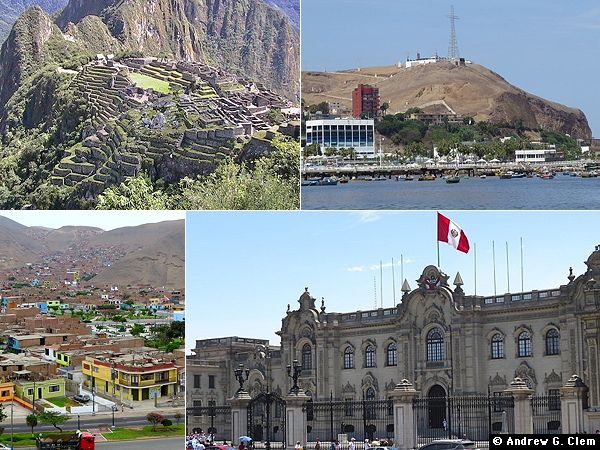
CLOCKWISE FROM TOP LEFT:
Machu Picchu, the lost city of the Incas;
Chorrillos, the seaside area southeast of Lima;
Palace of Government in Lima;
A residential neighborhood in Ventanilla Alta, north of Lima;
To see more photos of Peru, click on that composite image.
Peru is home to an amazing variety of plant and animal life, with the distribution corresponding to the three distinct geographic zones described above. Over 1,800 bird species can be found in Peru, more than in Europe and North America combined (1,400). Manu National Park, in the foothills of the Amazon Basin east of Cuzco, is the home to huge numbers of macaws and other colorful tropical birds.
At Paracas, on the coast south of Lima, a wide variety of nesting sea birds are found. It is under threat of development, however, principally from the natural gas pipeline terminal. In the past ten years, the estimated number of Humboldt's penguins there has declined from 40,000 to about 5,000.
In the Urubamba Valley north of Cuzco, many hummingbirds, tanagers, and exotic species are found. The Machu Picchu Historical Sanctuary includes over 400 species of birds.

Clockwise from top left: Yellow-hooded Blackbird, Least Bittern, Great Egret, Striated Heron, Many-colored Rush Tyrant, Harris's Hawk (J), Great Grebe, Ruddy Turnstones. (At the Pantanos de Villa, south of Lima, Feb. 27, 2017)
The only major, well-organizaed party in Peru is APRA, the American Popular Revolutionary Alliance, led by Alan Garcia. The Popular Action party founded by moderate reformist Fernando Belaunde (who passed away in 2002) has lost ground in recent years, as has Fujimori's "Change 90 / New Majority" party since he fled the country amidst scandal in October 2000. One bright spot recently has been the Peruvian-Bolivian cooperation on building highways and port facilities to help landlocked Bolivia trade more easily with the outside world. Chile, which seized former Peruvian and Bolivian lands in 1879, often refuses to listen to Bolivian concerns about transportation issues.
In 2001, Alejandro Toledo (educated at Stanford University narrowly defeated former President Alan Garcia, a charming fellow whose anti-American rhetoric just about drove Peru into the ground during the late 1980s when he was president. Garcia won in 2006, and even though his second term was better than the first (1985-2000), corruption scandals left his legacy in tatters once again. Retired colonel Ollanta Humala served as president from 2011 until 2016. In June 2016, financial expert Pedro Pablo Kuczynski won the runoff presidential election against Keiko Fujimori, and was inaugurated on July 28. Kuczynski holds dual Peruvian-U.S. citizenship. In March 2018 he was impeached and removed from office in the midst of a far-reaching bribery scandal involving the engineering firm Odebrecht, replaced by Martin Vizcarra, who was himself impeached and removed from office, replaced by Manuel Merino in November 2020.
In March 2018, conservative President Pedro Pablo Kuczynski was impeached and removed from office on corruption charges related to the Odebrecht scandal. Two years later the same thing happened to the man who replaced him, as President Martin Vizcarra was removed from office in November 2020, during the covid-19 pandemic. In December 2022, Congress removed Pres. Jose Pedro Castillo, a leftist who was governing in an authoritarian style, and tried to close Congress. More recently Congress also removed his successor, Pres. Dina Boluarte (2025), as well as Pres. Jose Jeri (2026). The election of Keiko Fujimori, daughter of the controversial late Pres. Alberto Fujimori (1990-2000) creates a new atmosphere of uncertainty about whether she will follow her father's populist autocratic style of governance or seek institutional stability.
NOTE: Width of each column shows each party's approximate strength. Colors and position (left to right) represent ideological leanings, which are often vague. Numbers show how many seats each party has in the unicameral Congress. Minor parties are not shown.
SOURCE: CIA World Factbook, onpe.gob.pe, peru.com, La Republica
| Began | U.S. Ambassadors to Peru |
|---|---|
| 1961 | James Loeb |
| 1963 | J. Wesley Jones |
| 1969 | Taylor Garrison Belcher |
| 1974 | Robert W. Dean |
| 1977 | Harry W. Schlaudeman |
| 1980 | Edwin G. Corr |
| 1981 | Francis Vincent Ortiz, Jr. |
| 1984 | David C. Jordan |
| 1986 | Alexander Watson |
| 1989 | Anthony Quainton |
| 1992 | Alvin Adams |
| . | Dennis Jett |
| . | . |
| . | . |
| . | James Curtis Struble |
Historically, Peru's military forces have played a large role in shaping the domestic political system. Often they have sought to prevent radical leaders from taking over, but at other times (especially 1968-1980) they assumed an ambitious role in reshaping the country's economic and social system. During the 1980s and 1990s they were focused on suppressing extremist left-wing movements such as Sendero Luminoso (Shining Path) and the Movimiento Revolucionario Tupac Amaru. As part of this effort, they have also tried to control trafficking of coca derivatives and other illegal drugs. During the late 1970s Peru acquired hundreds of tanks and dozens of fighter jets from the Soviet Union, creating a fear in the U.S. of a "second Cuba." Peru has a strategic rivalry with Chile, which conquered Peruvian land during the 1879-1883 War of the Pacific. There were rumors of a possible war with Chile during the mid-1970s, and tensions have occasionally escalated since then. Peru also faces a strategic challenge from Ecuador, and territorial disputes erupted into military conflicts in 1941, 1981, and 1994.
| Personnel (active) |
Spending (US $ billion) |
Ground divisions |
Main battle tanks | Major naval vessels | Cruisers | Frigates | Submarines | Combat aircraft | Jet fighters | Helicopters |
|---|---|---|---|---|---|---|---|---|---|---|
| 115,000 | $3.0 bn | 13 | 300 | 13 | 1 | 4 | 8 | 121 | 97 | 19 |
Radio Programs of Peru -- a commercial network that is probably the best all-around source of news from Peru.
Adonde.com ("Where to?") A directory of Peruvian Web sites, with some news summaries (in Spanish).
Peru.com -- A commercially-oriented, graphics-laden Web site on Peru, with some news summaries (in Spanish).
Peru Times (in English)
Caretas, the "Time magazine" of Peru. (in Spanish)
APRA (political party)
Alberto Fujimori's official Web site: "From Tokyo" (English version) He is eager to run for president and lead the nation once again.
"Peru's Unlikely Capitalist," by Stephen Johnson, at heritage.org (December 12, 2006)

