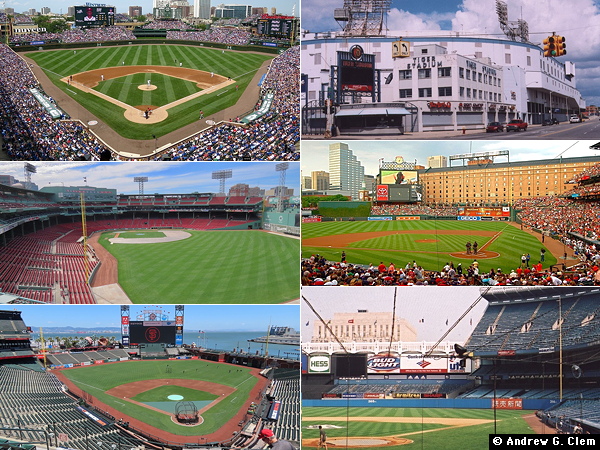
(Roll over the respective miniature images on the left to see the corresponding thumbnail diagrams on the right. Click on them to go to the respective stadium pages.)
Stadium diagrams: Introduction

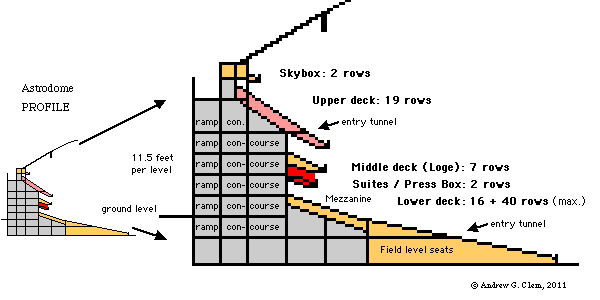
The central feature of this Web site are the stadium diagrams, which are rendered from a naturalistic top-down "eagle-eye" view, not the kind of "exploded" view used in seating charts to reveal the sections covered by upper-tier decks. The profiles in each diagram usually represent a "typical" part of the grandstand, but bear in mind that in many stadiums (especially newer ones) the mezzanine level behind home plate contains the press box rather than fan seating. To avoid unnecessary clutter, the diagrams generally omit certain details such as batting circles or the coaches' boxes near first and third base. Some minor idiosyncrasies such as the shape of the dirt infield and basepaths are included for some stadiums where appropriate. Originally, most diagrams had the left or right field lines vertical, so that center field was at a 45 degree angle, and the dirt (or cinder) warning tracks around the field perimeters were omitted. Note that there is some variation among the diagrams in terms of "refinement." That is, some diagrams are four or five years old and lack some features such as detailed attention to the profile (showing the stadium "innards") or the entry portals. Others include some but not all of those features, and some are fully "up-to-standard." I am carrying out a steady, long-term project of bringing nearly all of the diagrams up to the same standard. For the past three or so years, all of the diagrams have home plate located at the same X-Y coordinate, facilitating easier comparison on the Side-by-side and Overlay comparison pages.
Periodic Table of Stadiums

This "Periodic Table of Stadiums" uses chemistry. (See August 25, 2018 blog post.)

Preview of the forthcoming Clem's Baseball Stadium Evolution poster.
"Dynamic" diagrams
(JAVASCRIPT REQUIRED!) Most older stadiums underwent major expansion or renovation one or more times, and the diagrams indicate this with small arrows and the year of expansion in parentheses. In cases where the change was especially drastic, the diagram has been made "dynamic," meaning that the original version originally appears when the page is first loaded in your browser program, and the subsequent version(s) appear(s) when you roll the mouse cursor over the diagram (and away from it), without clicking. For most of the stadiums where pro football was played, the football gridiron and temporary football-only seating sections are indicated.
Diagram accuracy & scale
Generally speaking, the diagrams are accurate to within a few feet, i.e., one or two pixels. As a scholar and as a member of the Society for American Baseball Research, I aspire to uncover historical facts and share my findings with others who have a like interest. There are certainly a few errors in the diagrams, and I appreciate fan feedback, which has proven invaluable in helping to making the diagrams more and more accurate over time. I acknowledge helpful tips from fans on the respective stadium pages. Estimates for the position of the fences and walls lining the playing field are more accurate than for the exterior walls. The scale is identical in all of the diagrams: 3 pixels = 5 feet. Whatever your computer's configuration, you can make easy direct comparisons between virtually ANY two major league stadiums built since the early 20th century.
How do I do this?
My techniques are too difficult to describe in a brief fashion, but is basically involves "reverse engineering," looking at photos from many different angles, and comparing data on dimensions from various sources. I count number of rows in photos to derive estimates of how deep the grandstands and bleachers are. The depth of seating areas is based on a rule of thumb that each row is about 2.7 feet deep. Rows tend to be narrower in bleacher areas, and in nearly all older ballparks compared to modern-day stadiums. I also use seating diagrams published in team programs, and shown on Web sites, but those diagrams are typically not very accurate. Even though they are representations of real-world objects, these renderings are original works of art protected under U.S. copyright laws, and full respect for intellectual property rights is a condition for use of these pages.
What's in a (stadium) name?
Please bear in mind the following standard practices I've adopted: I use the commonly accepted names of the stadiums, not necessarily the current (and often short-lived) name of the corporate sponsor, indicating with an asterisk those stadiums that were subsequently renamed. Quotation marks indicate new names, but in some cases (e.g., "Tiger Stadium") that is the name that gained currency, whereas many people kept calling Shibe Park by its original name rather than "Connie Mack Stadium." As explained in the notes below, in some cases the name changed subsequently, as indicated by quotation marks. See the Stadium names chronology page.
Frequently Asked Questions
(The most recent additions are on top.)
Q: How can I use these diagrams to find out how far a particular home run went, or how far it is (or was) to a particular part of the outfield fence?
Here's a handy tip mentioned on my July 10, 2012 blog post: Just go to Stadiums superimposed page, choose "distances" (at the bottom of the scrolling menu) for the Reference stadium (opaque / dark) and then your choice of Comparison stadium (translucent / pale). Voilà!
Q: Is this a baseball Web site, or isn't it??
Yes. Baseball fans have always accounted for the vast majority of visitors to my site, and even though I put much more time and effort into my baseball pages than to the other pages, I also "blog" about politics and other topics. As for the non-blog informational pages, Latin America is the most comprehensive section.
Q: What is the "paired swivelable circular section lower deck" (PSCSLD) configuration?
It is my term for stadiums whose lower deck sections, which form an acute angle during baseball games, are moved around to face each other in parallel across the field during football games. This design feature was ultimately adopted by seven of the circular hybrid stadiums: Shea Stadium, the Astrodome, Busch Stadium II, Arlington Stadium, Three Rivers Stadium, and the Rogers Centre (Skydome). RFK Stadium and Riverfront Stadium were similar, but only one side of the lower deck moved.
Q: On the pages with "dynamic diagrams," why do some of the diagrams include details that are not appropriate for the indicated year?
A: Each successive diagram version represents what the stadium was like for most of the period in question, but is labelled according to the year in which the most significant change for that phase occurred. Therefore, the 1940 version of Fenway Park (when the bullpens were moved in front of the bleachers in right field) shows the light standards (those tiny gray squares), even though the lights were not installed until 1947. There were no major changes in Fenway Park through the 1970s, more or less, so the most accurate representation of the entire 1940-1980 period is to include those light standards.
Q: Why don't I show more complete historical data on outfield dimensions and stadium capacity?
A: I never intended this Web site, which occupies its own, special "cyber-niche," to be a comprehensive or definitive source of information. My research relies almost exclusively on published (secondary) sources, especially Phil Lowry's exhaustive reference work, Green Cathedrals.
Q: How do I decide how many versions to make when I do a "dynamic diagram," and for which time periods?
A: I try to limit the number of versions so that only significant modifications to the stadium or playing field are included. Three or perhaps four is fine, but five is pushing it. Some stadiums went through dozens of changes in outfield dimensions over the years (e.g., Braves Field), and I have to draw a line somewhere. My general practice is to only include diagram versions that represent a signficiant period of time, at least several years. I make a few exceptions if there is a special reason for doing so.
Q: Will I do diagrams and/or pages for major league stadiums prior to 1909?
A: I plan to cover ballparks in use during the first decade of the twentieth century, but probably not for 19th Century ballparks, because data on them are scarce and unreliable.
Q: Will I do diagrams and/or pages for minor league stadiums?
A: Probably not for the foreseeable future, and certainly not more than a few of them.
Q: Will I do diagrams and/or pages for football stadiums?
A: Almost certainly not, but I would consider collaborating with someone who has such an interest.
Q: How the heck do I draw those diagrams?
A: Basically, I start with the published dimensions for each stadium, do a lot of trial-and-error drawing on the computer to get the outfield angles and curves as accurate as possible, using photographs in books I own as well as on the Internet, and then do the grandstand, counting the number of rows in each deck and looking at profile photographs to get the proper overhang and slope for each deck. Sometimes I come across blueprints or line drawings that are very useful as well. It's an extremely time-consuming process, and as a highly-specialized craft it's rather hard to explain.
Q: Which stadiums feature the home team's logo painted behind home plate?
A: See Sept. 8, 2012 blog post.
(MORE TO COME...)
(MORE TO COME...)
* Those changes were announced in late 2011, and went into effect prior to the 2013 season. (Formerly displayed on the Baseball blog page.)
"#" signifies newly-added items (as of August 2026).
Published sources:
Books (General)
Books are listed in alphabetical order, by author's last name. The number of baseballs ( ) indicates how good the book is, mainly in terms of how useful it is for purposes of baseball stadium research. 1 = fair; 2 = good; 3 = very good; 4 = excellent
Dean V. Baim, The Sports Stadium as a Municipal Investment (Greenwood Press, 1994).
(?) John Bale & Olof Moen (eds.), The Stadium and the City (Keele, Staffordshire, U.K.: Keele University Press, 1995)
Michael Benson, Ballparks of North America: A Comprehensive Historical Reference to Baseball Grounds, Yards, and Stadiums, 1845 to Present (Jefferson, NC: McFarland & Co., Inc., 1989)
John Durant, The Story of Baseball in Words and Pictures, (New York: Hastings House Publishers, 1974)
Michael Gershman, Diamonds: The Evolution of the Ballpark (Houghton-Mifflin, 1993). A very good chronological development with many fantastic ancient photos, but somewhat plagued by uneven quality and scrambled sequencing.
(?) Geraint John, Rod Sheard & Ben Vickery, Stadia: A Design and Development Guide, 4th ed. (Oxford, U.K.: Elsevier/Architectural Press, 2007)
James R. Hartley, Baseball at RFK Stadium, (Silver Spring, MD: Corduroy Press, 2008) Dozens of excellent photos from construction in 1960 to the Nationals' final game at RFK in September 2007.
 Philip J. Lowry, Green Cathedrals 3rd ed. (Walker, 2006). An excellent, nostalgic book filled with statistics and fun facts about ALL past major league ballparks, including Negro League parks and those back in the 19th century. The previous (second) edition published in 1992 was the inspiration for my renewed interest in baseball stadiums. It is highly recommended for baseball scholars and regular fans alike.
John Pastier, Historic Ballparks, (Chartwell Books, 2006). A coffee-table-sized book full of old and new photographs, historical analysis, statistics, diagrams from the 1950s, and drawings of pre-concrete era ballparks by Rick Okonen.
Phil Pepe, The Yankees: An Authorized History of the New York Yankees, updated Centennial edition (Taylor Trade Publishing, 2003).
Lawrence Ritter, Lost Ballparks, (Viking Penguin, 1992). Great photos for many old stadiums, including some minor league parks, but excluding several major league parks of note.
Yankee Stadium, USA Today Sports Weekly Keepsake Edition (2008)
Ira Rosen, Blue Skies, Green Fields: A Celebration of 50 Major League Baseball Stadiums, (Clarkson Potter Publishers, 2001). Superb professional photos of nearly all the recent stadiums, with mixed-quality photos of many older major league parks. Includes 300 quotes from players, managers, and other baseball personalities.
Glenn Stout, Fenway 1912: The Birth of a Ballpark, a Championship Season, and Fenway's Remarkable First Year (New York: Mariner Books, 2011) A thorough history of Fenway Park's origins, with plenty of photos and architectural drawings.
Ron Selter, Ballparks of the Deadball Era: A Comprehensive Study of Their Dimensions, Configurations, and Effects on Batting, 1901-1919 (Jefferson, NC: MacFarland & Co., 2008)
Geoffrey C. Ward and Ken Burns, Baseball: An Illustrated History (Alfred A. Knopf, 1994). This is the "companion volume" to Ken Burns' famous series on PBS. See review at Civic religion
Donald Whitford, Playing Hardball: The High Stakes Battle for Baseball's New Franchises (New York: Doubleday, 1993). Chronicles the promotional campaigns and back-room intrigues that brought new baseball teams to Denver and (Miami) Florida in 1993.
Bob Wood, Dodger Dogs to Fenway Franks: The Ultimate Guide to America's Top Baseball Parks (McGraw-Hill, 1988). The author made a pilgrimmage to all 26 major league stadiums in 1985, and thus (unlike me) has a first-hand basis for judging which stadiums are better than others. I just can't figure out some of his rankings, however.
Andrew Zimbalist, Baseball and Billions: A probing look inside the big business of our national pastime (New York: Basic Books, 1992). The author is the nation's foremost expert on baseball finances.
Books (specific stadiums)
Furman Bisher, Miracle in Atlanta: The Atlanta Braves Story (Cleveland and New York: World Pub. Co., 1966)
Philip Bess, City Baseball Magic: Plain Talk and Uncommon Sense About Cities and Baseball Parks, (Knothole Press, 1989). A polemic against New Comiskey Park, with a proposed alternative designed to better fit into (and thus revive) Chicago's south side. (Thanks, Connie!)
Ray Robinson and Christopher Jennison, Yankee Stadium 2nd ed. (Viking Studio, 2004)
Yankee Stadium 1923-2008, by Gary Hermalyn and Anthony C. Greene (Arcadia Publishing, 2009)
Bob McGee, The Best Ballpark Ever: Ebbets Field and the Story of the Brooklyn Dodgers (New Brunswick, NJ: Rivergate Books, )
(?) Richard Bak, A Place For Summer: A Narrative History of Tiger Stadium (Wayne State University Press, 1998)
(?) Rich Westcott, Veterans Stadium: Field of Memories (Philadelphia: Temple University Press, 2005)
(?) Costas Spirou & Larry Bennett, It's Hardly Sportin': Stadiums, Neighborhoods, and the New Chicago (Dekalb: Northern Illinois University Press, 2003)
Annual publications
Roger Kahn (ed.), The Mutual Baseball Almanac (Garden City, NY: Doubleday & Co., 1954) Included stadium diagrams, as well as player and team statistics.
Baseball Stadiums 2003 Panoramic Calendar, photographs by Jim Dow (San Francisco: Chronicle Books LLC, 2002). Exquisite detail.
J.G. Taylor Spink and others, Baseball Guide and Record Book (St. Louis: Charles C. Spink & Sons, 1947) Included cartoon drawings of each team's stadium, adorned with lots of fascinating historical tidbits, as well as player and team statistics.
Sports Staff of USA Today, The Complete Four Sport Stadium Guide (Fodor's Travel Publications, 1996).
Street & Smith's Baseball Yearbook
The Sporting News Baseball (Yearbook Series)
The ESPN Information Please Sports Almanac, Gerry Brown and Michael Morrison, eds.
Copyright © Andrew G. Clem. All rights reserved. Use of this site indicates your agreement to the Terms of Use.


 Many of those pages include one or more photos taken by me, or by fans of this Web site. The rest of this page explains what you will find on those pages.