Photos!
ALL-STAR GAME: 1960 LIGHTS: 1940s
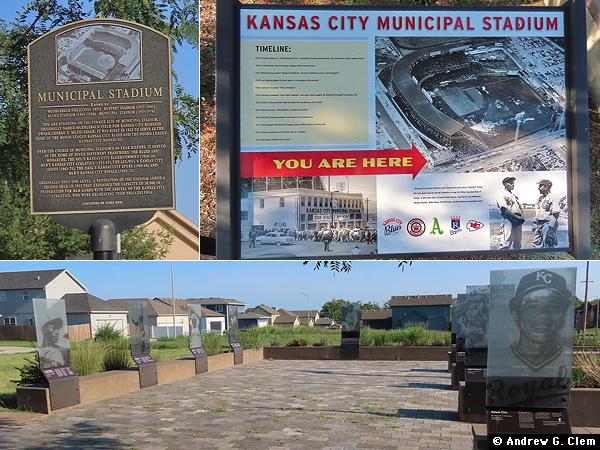
BEEN THERE (TOO LATE): I stopped at the site of Municipal Stadium in August 2002, July 2014, July 2017, and August 2025; see photos below.
Municipal Stadium was an old minor league ballpark, originally called Muehlebach Stadium, later Ruppert Stadium (after the owner of the Yankees who bought the Kansas City Blues franchise in 1937), and then (after 1942) Blues Stadium. It was one of the most prominent of all Negro Leagues venues, hence the Negro Leagues Baseball Museum in the nearby 18th & Vine historic district of Kansas City. In the early days, the outfield distances were enormous, and the steep slope in right field was in play. Among the very few players ever to hit a home run over the exterior wall was Babe Ruth, in an exhibition game in the 1930s. In 1937 they installed inner fences that reduced the distances somewhat. (The red borders on the distance markers in the 1923 and 1942 diagrams indicate doubt about the measurements.)
In 1955 the Blues Stadium was expanded, with the help of public money, to accommodate the former Philadelphia Athletics when they moved west from grand old Shibe Park. It was also renamed "Municipal Stadium." They simply built a big new second deck on top of the original grandstand, raising the seating capacity from about 17,000 to about 30,000. As part of the upgrading to major-league standards, home plate was moved forward about 18 feet. (According to Lowry's Green Cathedrals, the shift was 25 feet. Also, he states that the backstop distance was 60 feet in 1955 and 70 feet as of 1963, but I think it was 70 feet throughout the 1955-1972 major league era. The discrepancy may reflect a change in plans while Municipal Stadium was being rebuilt during the winter of 1954-1955.)
In terms of its rounded rectangular shape, Municipal Stadium bore some resemblance to Roosevelt Stadium, in New Jersey. Note that during part of its lifetime as a minor-league ballpark, they took out the outfield fence, so that fair territory extended all the all to the exterior walls along the streets, including the steep slope in right field. Outfield dimensions for the minor league era appear inconsistent with available photographs, and should be regarded with caution.
Municipal Stadium was built in a hilly part of the city, and the playing field was carved into a large slope which was most pronounced on the southeast side, near the right field foul pole. The rear of the lower deck in that corner was at ground (street) level, whereas on the third base side, it was 10-20 feet above the street. The biggest peculiarity was that the left side of the grandstand only reached a short distance beyond third base, after which a grass slope continued. Permanent seats were installed along that side in 1961. There were no seats beyond the outfield fence while the A's played there, though in some games overflow crowds sat along the steep grass slope on the right field side leading up to the street level. Bleachers were built there in 1969 and/or 1971. Some time in the early 1960s, a large entry portal was carved into the lower deck near the right (home team) dugout, in part to provide easier access for fans in wheelchairs.
Much like Braves Field (from whence the scoreboard came, in fact), the outfield fence was shifted back and forth several times, and dimensions are notoriously uncertain. Based on the dimension data, it appears that the inner fence in left field was removed in 1961, and the light tower was moved back to the perimeter wall. The inner fence was put back once again in approximately the same place a year later, and then removed permanently in 1965. In 1964 (only), there was an inner chain link fence that reduced the distance to center field from 421 feet to 410. In right field, the fence evidently stayed put except near the corner, where a curved section was built near the foul pole in 1963 (reducing the distance by 15 feet), and in 1965, when Charlie Finley had a 296-foot "KC Pennant Porch" built in right field to mock Yankee Stadium's short right field. The Commissioner of Baseball ordered him to move the fence back to 325 feet, the regulation minimum. The dimensions more or less settled down by the time the Royals moved in in 1969. New, larger dugouts were built in the early 1960s, and two rows of seats were added where the old dugouts had been. Likewise, the height of the fences was changed often: the left field fence ranged between 10 feet and 38.5 feet (1959-1960 only), and in 1967 the right field fence was raised to a bizarre 40 feet. It was restored to a normal 13 foot height in 1969, when the Royals began playing.
 The Athletics, also known as the A's, did not fare much better in K.C. than they had in Philadelphia. Nevertheless, there were few noteworthy players from that era, such as Rusty Staub, Bert Campaneris, and Catfish Hunter. In 1965 the famed Negro League pitcher Satchel Paige was brought back to the majors to pitch briefly at age 59, thereby allowing Paige to qualify for a major league pension, which he clearly deserved. A's owner Charley Finley made this ballpark into something of a carnival, often riding the team mascot donkey "Charlie O" around the field. Trees were planted and a children's petting zoo was put in the northwest corner, while sheep grazed on the slope beyond the right field fence. There was a mechanical rabbit named "Harvey" that dispensed baseballs from underground behind home plate for the convenience of the umpires. In the mid-1960s, the scoreboard was extended about 20 feet to the right with a "Fan-R-Gram" message board. But none of these quirky amusements really paid off. After a dispute with Kansas City over lease terms, in 1968 Finley suddenly decided to move his team to Oakland, where the new Coliseum was awaiting.
Kansas City was in an uproar after the Athletics left town, so Major League Baseball responded by giving the city one of the American League expansion franchises in 1969, along with Seattle (home of the short-lived Pilots). The name of the new team, the Royals, was chosen to pay homage to the old Negro League franchise that used to play in Municipal Stadium, the Monarchs, famed pitcher Satchel Paige's team. When the Royals began playing in 1969, more temporary bleachers were added in right field, raising Municipal Stadium's capacity to about 35,000. But it was understood that the old stadium suffered the same problems as all the other inner-city stadiums (crumbling facilities, lack of parking, etc.), and the city agreed to help fund construction of a new stadium. The Royals moved into their sparkling new home at Royals Stadium (now called "Kauffman Stadium") in 1973.
After moving from Dallas and changing their name from "the Texans", the Kansas City Chiefs played football at Municipal Stadium from 1963 until 1971. With temporary bleachers installed in left field, the capacity was raised to 47,000.
From the historical marker at the site, I learned that the Beatles played here on September 17, 1964, opening with the song "Kansas City," as fans stormed onto the field. For several years after the demolition in 1976, this land was used as a community garden in a project sponsored by the United Way. When I visited the site in 2002, however, it was just a weedy vacant lot next to an old school. Since then a new housing development has been built on that plot of land; the surrounding neighborhood is full of older single-family homes.
SOURCES: Lowry (2006), Pastier (2007), Ritter (1992), Gershman (1993), Ward and Burns (1994), Rosen (2001), www.ballparksofbaseball.com, www.stadiumpage.com/stadiumgraveyard/kc.html, baseball-fever.com
FAN TIPS: Greg ?, Bruce Orser
| The Clem Criteria: | |||||
|---|---|---|---|---|---|
| Field asymmetry |
Architectural design |
Seat proximity |
Location * | Aesthetics | Overall |
| 6 | 4 | 5 | 4 | 4 | 4.6 |
* See the Stadium locations page. KC Memorial Stadium stood at the intersection of Brooklyn Avenue and 22nd Street.