Photos below!
ALL STAR GAME: 2002
BEEN THERE, DONE THAT: I had lunch at Friday's Front Row restaurant on August 2, 2010.
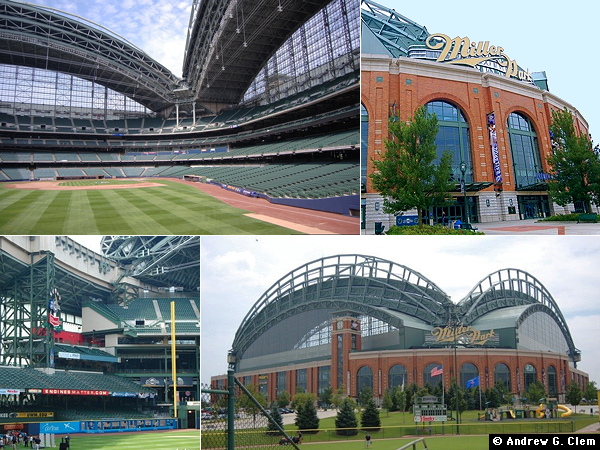
This gaudy jewel is certainly unique, in many ways. It is the only enclosed stadium in which the roof panels are arranged in a fan shape, which actually makes a lot of sense when you consider the acute angular layout of nearly all baseball stadium grandstands. This design results in a sizable amount of "dead" space at the extreme ends of those roof panels, behind the upper decks. The Brewers franchise offices occupy the space beyond the right field corner, and several conference rooms occupy the space on the other side. Because of its wide "footprint" and daunting sky-high ceiling, Miller Park is said to feel less intimate than its predecessor, County Stadium, even though it has about 11,000 fewer seats. The overall fan shape gives rise to several distinctive features, such as the huge glass paned window beyond the outfield and behind each wing of the grandstand. The outfield fence includes seven angles, most of which are too minor to have much effect on play, and which are in any case contrived. Much like Rangers Ballpark in Arlington, foul territory is very cramped, with long flanges in both corners, especially on the right field side. The way the upper deck gets bigger toward the foul poles is reminiscent of Chase Field, another retractable roof stadium. The symmetry of the overall structure likewise constitutes an exception to one of the basic criteria that define the neoclassical stadiums. About the only design features that really make it fit into that category are the brick exterior and the clock tower.
 Miller Park is only the second stadium (after Dodger Stadium) ever built with four main decks, and it is the only one in which the four decks extend from foul pole to foul pole. The front edge of the second deck is actually directly above the outfield fence in the left field corner, and many home runs pass under that deck into a restaurant (TGI Friday's Front Row), just as in Busch Stadium II. Another quirk is the fact that the the bullpen on the right field side is situated under the second deck. Both the first and second deck in right field are old-fashioned bleachers, not individual seats. As with most other recent stadiums, Miller Park is full of eateries and watering holes, of which the most obvious is located in the third deck overlooking the left field corner. Perhaps the biggest fan-friendly trademark at Miller Park is the waterslide down which "Bernie the Brewer" plunges every time the home team gets a home run. It is located at the end of the upper deck in left field, wrapping around one of the massive support columns. (See diagram.)
The gargantuan roof itself is worthy of extensive discussion. Its apex (on the outside) is 330 feet above field level, nearly as high as the distance down the foul lines. The roof has seven wedge-shaped sections, two of which are permanent and five of which pivot in back of the upper deck behind home plate. Note the two support columns in that area shown in the diagram above. The "Bob Uecker" seats behind them have a partially obstructed view and are sold at a discount. Also note in the diagram that the arches account for the varying height of the roof. Three roof sections rest on the left side of Miller Park when the roof is open, and two rest on the right; the arch of each successive section is higher than the previous one. There are four support columns for the roof arrayed along the outfield perimeter, and the "bulge" in center field (which at first glance seems odd and contrived) was put there to accommodate two of those columns.
Built just to the south of where County Stadium used to stand, Miller Park was originally scheduled to open in 2000. Construction was delayed for several months, however, after the huge crane was blown over by high winds. Three workers were killed in that tragic accident.
It took a few years before the Brewers had a winning season in their new ballpark, but they finally established themselves as a competitive force in the National League. They even won the NL wild card slot in 2008, but advanced no farther in the playoffs. One very positive sign is that attendance has climbed steadily, currently averaging in the mid-30,000 range, and for the past four years has ranked eighth or higher among all National League clubs. Milwaukeeans were rightly proud to host the All Star Game in 2002 -- the first time since 1975 -- and expectations were high. The gala event was spoiled, nonetheless, when Commissioner Selig declared the game over even though the score was tied, because both teams ran out of pitchers in the extra innings. To rectify that monumental goof, MLB officials changed the rules so that the winning league's team got home field advantage in the World Series, making sure that the 2003 All Star Game counted. At least something good came of that.
Prior to the 2006 season, the right field fence was moved in several feet to create a new picnic area, taking the place of a manual out-of-town scoreboard. There was some confusion over the distance to the right field corner, which according to Phil Lowry was 355 feet originally, but a first-hand source affirms that it has been 345 feet all along. That scoreboard was positioned diagonally, connecting the bullpen to the foul pole. Another recent change was the addition of the Harley-Davidson deck behind the bullpen in left-center field. Milwaukee is the corporate headquarters for the esteemed motorcycle manufacturer. The Brewers have had a fair amount of success in recent years, getting a wild card berth in 2008 and winning the NL Central Division in both 2011 and 2018. They lost to the L.A. Dodgers in the 2018 NLCS, and to the Washington Nationals in the 2019 NL Wild Card Game. In three of those four cases they lost to the eventual World Series champions: the Philadelphia Phillies (2008), the St. Louis Cardinals (2011), and the Washington Nationals (2019).
In January 2021, Miller Park was officially renamed "American Family Field"; see Stadium names chronology.
SOURCES: Lowry (2006), Pastier (2007), Washington Post (Jan. 16, 2002); Street & Smith's 2003 Baseball; www.jsonline.com; www.wikipedia.org
FAN TIPS: Bryan Johnson, Mark London
| The Clem Criteria: | |||||
|---|---|---|---|---|---|
| Field asymmetry |
Archi- tectural design |
Seat proximity |
Location * | Aesthetics | Overall |
| 5 | 7 | 7 | 3 | 6 | 5.6 |

* See the Stadium locations page.
Visit Milwaukee!
If you like beer, you'll love Milwaukee! The home of the Brewers is about a mile southwest of the Miller brewing complex, but it's over two miles from downtown Milwaukee. So, you'll need to plan ahead transportation-wise if you want to get to know the city itself, or if you'd like to sample some of the many other brands of malt beverages that are crafted there. Downtown is centered on the confluence of the Milwaukee River (flowing from the north) and the Menomonee River (flowing from the west), and boating is a popular local activity.
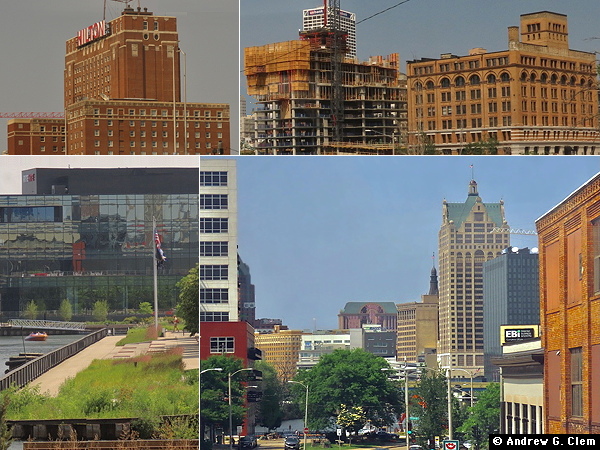
CLOCKWISE FROM TOP LEFT: Hilton Hotel; construction downtown; the Milwaukee skyline from the south; and a downtown park along the Milwaukee River.