

 Photo below!
PRO BOWL: 1980 - 2009, 2011 - present
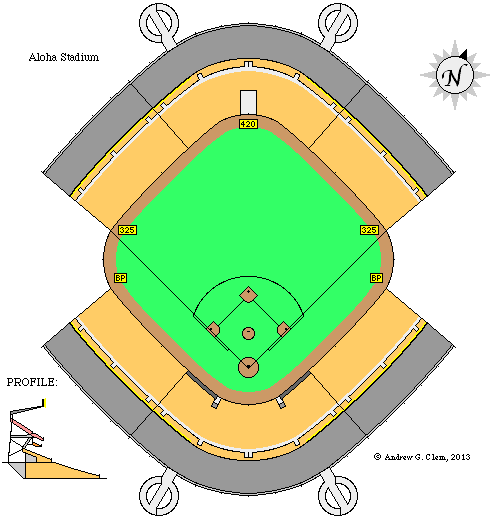
Aloha Stadium is notable for its unique solution to the baseball-vs.-football stadium conundrum: four massive double-decked sections pivot to convert a rounded square ("octorad") into an oval. It is interesting that this "hybrid" stadium was built at about the same time that Mile High Stadium was expanded, as they both featured moving grandstands, an innovation of the 1970s. Whereas the one in Denver used water as a cushion, the stands at Aloha Stadium rest on air cushions. Since it is of major league size, one wonders whether Hawaiians seriously lobbied to have an an expansion franchise put in Honolulu. The travel requirements almost certainly make such a prospect highly impractical, but it is interesting to contemplate. Aloha Stadium is just a stone's throw from Pearl Harbor and the U.S.S. Arizona Memorial.
 Structurally, Aloha Stadium (in its baseball configuration) bears a certain resemblance to the two "octorad" stadiums: Veterans Stadium and Jack Murphy Stadium. At first glance, the reconfiguration scheme is ingenious, but for baseball purposes, Aloha Stadium has clear limitations. Most of the outfield seats are far removed from the playing field, making binoculars a necessity. Even the front-row seats near the bullpens are at least 60 feet from the foul line. From the players' perspective, the outfield is noted for short distances to the corners (about 320 feet), and a deep center field (about 422 feet). In that respect, it is like Minute Maid Park and several of the classic ballparks from the early 20th Century. The least desirable aspect of Aloha Stadium is the artificial turf, which in a green tropical paradise such as Hawaii is totally uncalled for. The scoreboard (not shown) is beneath the front edge of the upper deck in center field.
The Pacific Coast League Hawaii Islanders played baseball in Aloha Stadium from 1975 until 1987, after which the franchise moved to Colorado Springs because of scant attendance. In April 1997, the promotion-minded San Diego Padres (who have a very small exclusive franchise territory) hosted the St. Louis Cardinals in a series at Aloha Stadium, where their star Tony Gwynn used to play for the Islanders. Baseball has not been played at Aloha Stadium in recent years, however, and the grandstand is no long movable.
Most Americans are familiar with Aloha Stadium as the traditional site of the Pro Bowl, the NFL's (very anticlimactic) "All-Star" game. In the football configuration in Aloha Stadium, there are ramps connecting the upper and lower level concourses in the four wedge-shaped empty spaces. The front-row seats in the northern and southern corners of the grandstand (center field, and behind home plate, respectively) are 60 feet from the end zone, a rather large empty space. The movable grandstand sections are quite snugly position along the side lines, however, making it an excellent football venue for most fans. The Pro Bowl was played at Aloha Stadium every year from 1980 until 2009, but coming a week or two after the Super Bowl, it was considered one of the least consequential sporting events in this country. Well, at least the beautiful Hawaiian scenery made it worth watching. The NFL then decided to begin holding the Pro Bowl at the same venue as the Super Bowl, with the Pro Bowl preceding the Super Bowl for the first time, so both events in 2010 were held at Sun Life Stadium (a.k.a. Dolphin Stadium). "After further review," however, they went back to the old custom, and the 2011 Pro Bowl was held in Aloha Stadium once again. As in 2010, however, it was played one week before the Super Bowl, to be held at the new Cowboys Stadium in Arlington, Texas. Because of widespread criticism that the 2012 Pro Bowl was so dull and non-competitive, some have suggested that it be eliminated entirely. Perhaps the NFL should draw a lesson from the 2002 All-Star Game farce (tied 7-7) and provide some incentive to the American and National conferences so that future Pro Bowls will generate more fan interest.
In addition, Aloha Stadium has hosted the Hula Bowl (1975-1997), the Aloha Bowl (1982-2000), and the Hawaii Bowl (2002- present)
SOURCE: Lowry (2006); WEB LINKS: www.alohastadium.hawaii.gov, Google Earth, linkmeister.com
FAN TIP: Tom Haynes
