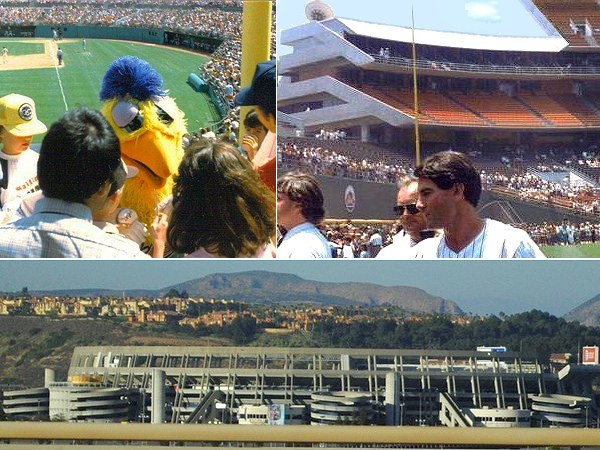
Photos!
ALL STAR GAMES: 1978, 1992 WORLD SERIES: 1984, 1998
SUPER BOWLS: 1988, 1998, 2003
Of the four new major league baseball franchises that were created in 1969, the San Diego Padres were the only one with a new (or nearly new) stadium. Their home, San Diego Stadium (as it was originally known), was the first of two "octorad"-design stadiums -- the other being Veterans Stadium in Philadelphia. This configuration, which combines features of a circle and an octagon, was an attempt to make a more efficient baseball-to-football switch compared to the circular "hybrid" stadiums which were pioneered earlier in the 1960s. In both cases, however, the results were unsatisfactory. The upper deck was much smaller than the "Vet," however. The only other stadium in the general class of "cookie-cutter""cookie-cutter" / "doughnuts" with such a small upper deck was Oakland Coliseum. Likewise, neither of those two stadiums had a roof.
When it first opened, this was a difficult place in which to hit a home run, with a distance of 420 feet to center field and an 18-foot high wall around the entire outfield. In 1973 a line was painted on this wall nine feet above the ground, and balls hitting the wall above the line were counted as home runs -- hardly an ideal solution. That same year a 10-foot high wooden fence was put up in center field, 410 feet from home plate, but it was removed after 1975. In 1982 an 8-foot fence was built a few feet in front of the wall around the entire outfield, and a row of potted palm trees was placed in the small gap, a nice bit of tropical scenery. The fact that the field consists of genuine Bermuda grass, and the lack of rainfall made this a pleasant venue for baseball, even if many of the seats are so far from the diamond, and pointed the wrong way. Another negative factor is the remote location of this stadium, about 15 miles north of downtown San Diego. It was built in what had been a marshy river valley -- not very friendly to the environment. The bullpens are located in foul territory at the right and left field corners, just like at Three Rivers Stadium. Intriguingly, the back ends of the bullpens, which are in play, could not be seen from the infield, so umpires had to scramble to get a view whenever long foul balls are hit into the corners. Another unique feature was that the dugouts were beneath the first couple rows of box seats, at ground level. According to Lowry (2006), the distance behind home plate was originally 80 feet, and was reduced to 75 feet in 1982. After a lot of study, I've decided that that is utterly impossible, given the stadium's geometry. My estimate is that the backstop was about 55 feet in back of home plate. It was reduced even further in the last two or three years of the Padres' residence there, when new box seats were installed between the dugouts (not shown in he diagrams).
 Originally, "San Diego Stadium" was very pleasing in appearance, with great background scenery and a large grass slope beyond right field. For a while they put temporary bleachers there, when needed, and then permanent seats with a concrete foundation. In 1981 the name was changed to "San Diego/Jack Murphy Stadium" in honor of the sports editor who had played a lead role in bringing professional football and baseball to San Diego. In 1984 the second deck and mezzanine level were extended by about eighty feet, wrapping around the center field and right field "corners," and the seating section in right field was greatly expanded. This raised the total capacity for baseball games to nearly 59,000. For the Super Bowl in 1988, about 15 more rows of seats were added in back on either side of the scoreboard, and temporary seating sections were installed in the four corners, angled in such a way to provide better sight lines for football.
The stadium was enlarged once again in 1998 by further extending the upper two decks on the right field side, leaving just a small gap that framed the scoreboard. The lights that had originally extended beyond either edge of the scoreboard had to be removed at this time. At about the same time, the stadium was renamed "QualComm Stadium" in exchange for monetary consideration from the company that makes semiconductor chips for cell phones, software such as the "Eudora" e-mail program, and other communications products. The new sections of the upper deck had several more rows than the older sections, and did not have lighting towers above them. Also, a new scoreboard was added in the right field wall, and the inner fence on that side was removed, increasing the distance by three feet. Because of sparse crowds in the Padres' last few years there, all of the upper deck sections (except for the corner behind the diamond) were closed off to baseball spectators, reducing the official capacity to just under 49,000. In 2003 all the seats were opened once again, and capacity in the stadium's final year was over 66,000, the biggest in the major leagues.
Though this stadium has been expanded and renamed over the years, until 2004 it was the only home the Padres ever had! San Diego was the only pre-1990s team that could make such a claim, and they were the first of three expansion franchises to enjoy a new (or almost new) home stadium in their inaugural year. (The others were the Mariners and the Diamondbacks.) The Padres have made it to the World Series only twice: in 1984 (losing to the Detroit Tigers) and in 1998 (losing to the Yankees scorewise, but beating them in attendance). During the 1984 postseason the grass in left field died because the field had been covered for several days when football games were being played.
Without a doubt, Tony Gwynn is the best player in the Padres' history, amassing a .338 batting average over his 20-year career, all with the Padres. It was fitting that this inspiring and gracious sportsman appeared in the World Series (in 1998) just before he retired. In 2007 he was admitted to the Baseball Hall of Fame, along with Cal Ripken. Tragically, Gwynn passed away in 2014.
Construction on the Padres' new home in downtown San Diego began in 2000, but prolonged squabbling over public financing caused a year-long delay. As PETCO Park finally neared completion, the Padres played their very last game in their original home in September 2003.
The San Diego Chargers began playing football here in 1967, two years before the Padres franchise was created. The original capacity for football games was 54,000. As a result of the 1998 expansion, the football capacity was raised to 71,000. However, the sight lines from the first several rows along the gridiron are so bad for football games (too low), that those sections were closed for the 2003 Super Bowl. Another annoyance is that since the Padres departed, they have added more seats at the corners of the gridiron, but they are angled in such a way that anyone sitting there would have to look straight to the right or left to see a touchdown play! It's an inherent defect of "octorad" stadiums, like Veteran's Stadium. Following a negative referendum vote on public funding for a new stadium in November 2016, the Chargers formally requested a transfer of their franchise to Los Angeles, which was their original home. They now play in the StubHub Center, the home of the Major League Soccer L.A. Galaxy, located in the industrial suburb of Compton. That left QualComm Stadium without any professional teams as tenants, and with the only resident team being San Diego State University, the structure was renamed San Diego Credit Union Stadium. After four years of "Limbo," demolition of the stadium began in late 2020.
The relocation of the Chargers rendered moot my proposal of rebuilding portions of the lower deck of "QualComm" Stadium and lowering the playing field by a few feet, so as to create better sight lines for football fans. (See the suggested alternative football design among the above diagrams.) With the comparatively modest scale of this suggested renovation, the cost would probably be less than $50 million -- a lot cheaper than building a brand new football stadium.
San Diego Stadium / Jack Murphy Stadium / QualComm Stadium also hosted the Holiday Bowl beginning in 1978, and the Poinsettia Bowl from 2005. It was also home of the San Diego State University Aztecs football team since 1967. After the Chargers moved from San Diego to Los Angeles in 2017, the Aztecs became essentially the only tenant of QualComm Stadium, and during the summer of 2017, it was renamed "SDCCU Stadium" after San Diego County Credit Union signed a naming rights contract. After arrangements to build a smaller replacement football stadium were made, demolition on the half-century old stadium began in December 2020, and was finished in March 2021.
SOURCES: Lowry (1992, 2006); USA Today / Fodor's (1996); Rosen (2001); Dow (2003)
FAN TIPS: Ed Early, Angel Amezquita
| The Clem Criteria: | |||||
|---|---|---|---|---|---|
| Field asymmetry |
Archi- tectural design |
Seat proximity |
Location * | Aesthetics | Overall |
| 3 | 5 | 5 | 4 | 6 | 4.6 |
* See the Stadium locations page.