

 Photos below!
ALL STAR GAME: 2009 WORLD SERIES: 2006, 2011, 2013 (W 2, L 1)
BEEN THERE, DONE THAT: Aug. 15, 2009 ("drive-by"), Aug. 17, 2011 (guided tour), Aug. 10, 2015 ("drive-by")
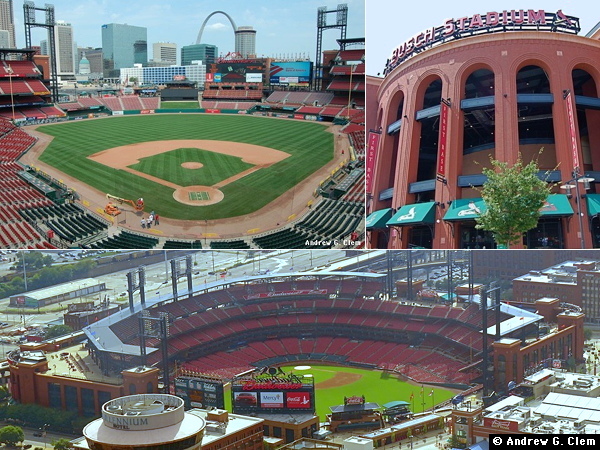
With a beautiful red brick exterior and steel arches along the roof and on top of the main entrances, this is one of the most self-consciously "retro"-design stadiums. That is entirely appropriate in the heart of one of the most enthusiastic and successful baseball cities in America. After repeated delays over financial issues, construction on a new baseball stadium in St. Louis finally began in early 2004. Because the portion on the north (left field) side overlapped with the previous Busch Stadium (II), it was not possible to complete construction by the time the 2006 season began. Thus, the seating capacity was only 37,962 on Opening Day in 2006, or 40,713 including standing room. About six thousand additional seats in the two upper decks around the left field corner opened to the public in late May, more than a month ahead of schedule.
My initial impression of this stadium was that it was too jumbled, with an unnecessary proliferation of various deck configurations. Hence the necessity for three separate profiles in the diagram above. From the bend near first base to right field, the lower deck extends back about ten additional rows, occupying the space where the two luxury suite levels would otherwise be. On the third base side, the fourth deck terminates just before the two light standards, on the other side of which the third deck extends back several extra rows, with a roof on top. The "interrupted" upper deck design feature has been used in all but two of the major league stadiums built since the turn of the century, and this case is most similar to Citizens Bank Park, which also has a lower-profile grandstand beyond the "gap." (The same thing applies to Nationals Park in Washington.) Another similarity -- also a recent trend in stadium design -- is that the upper deck is separated into two levels: the "Pavilion" (in front) and the "Terrace" (in back). This split upper-deck configuration provides a view of the field from the upper level concourse, perhaps to encourage fans to go buy food and drinks. One of the interesting features of the newest Busch Stadium is the close proximity of the upper decks to the left field corner. This made it possible to squeeze in an extra deck below the second deck; it is called the "Left Field Porch." Even though Anheuser-Busch no longer owns the Cardinals, the Budweiser logo is prominently displayed in several places, most notably on the scoreboard behind the upper deck in right center field. And on special occasions, the famous Budweiser Clydesdale horses parade around the warning track, entering through the portal near the right field corner; eight rows of seats are raised up on a big hinge to permit vehicles to enter.

Unlike the grandstand, the outfield is almost perfectly symmetrical in shape. This distinguishes it from the rest of the "Neoclassical" stadiums. The overall shape of the structure resembles the old Globe Life Park ("Rangers Ballpark in Arlington," etc.), but with the relative proximity of the upper decks to the field being reversed from right field to left. The fact upper decks are right above the left field fence in Busch Stadium, and vice versa for the one in Arlington. The fact that the upper decks bend inward at perpendicular angles to the foul lines is no doubt a subtle design tribute to the original Busch Stadium, a.k.a. "Sportsman's Park. One distinctive feature is the large size of the second deck, the "Loge" level; only New Yankee Stadium has a bigger second deck. Both those stadiums have unusually large upper-deck overhang, providing plenty of shade, at the cost of somewhat obstructed views. Real bench-style bleachers stretch from bullpen to bullpen, a thrifty option for fans in hard economic times such as these. One of the biggest advantages over the previous Busch Stadium (II) is the open view of St. Louis skyline beyond the outfield, especially the world-famous St. Louis Gateway Arch. All in all, it seems to be a very good stadium -- not outrageously fancy, not too big, and not too small. Just about right.
Busch Stadium III is situated on a gradual slope, with the ground level on the north side being about 15-20 feet higher than on the south side, where cars zoom past on the Interstate 64 elevated freeway. The "Ford Plaza" in back of the bleachers is at the same level as Clark Street (on the left field side), which is about 5-6 feet higher than the main concourse, which in turn is a full level (about 12-13 feet) above the entrance behind home plate. The lower deck version diagram above indicates the approximate location of discontinuities in the elevation of the main concourse. On our guided tour, for example, I was surprised to see a flight of stairs leading up from the ground level behind home plate toward the first base side. Instead, we turned left into a maze of hallways that led past the players' locker rooms, eventually emerging through a tunnel in back of home plate, where the elite Cardinals Club seats (colored blue-green, not red) are located. The "Champions Club" and "Legends Club" private suites situated below the Loge level have exclusive seats at the very back of the lower deck, but separated from the rest of the lower deck. It's an ambiguous situation, which is why those seating areas are colored red rather than pale orange. Note that the view from those sections is rather constricted by the upper-deck overhang. While on the field, I noticed several large fans hung beneath the upper deck, to provide fresh breezes for the folks sitting in the Loge level.
The new Busch Stadium proved to be just as beneficial to the Cardinals' fortunes as the previous version had been: In its very first year in operation, 2006, the Cardinals won the National League pennant, and went on to beat the Detroit Tigers four games to one in the World Series. (The last three games were at home in St. Louis.) The Cards thus became the fourth baseball team ever to win a world championship during the inaugural year of their new stadium; the previous such teams were the Pittsburgh Pirates (1909), the Boston Red Sox (1912), and the New York Yankees, who did it twice (1923 and 2009). Renowned slugger Albert Pujols led to team to amazing success, but the franchise owners were unwilling to meet his demands for a renewed contract, and signed with the L.A. Angels after the 2012 season. No matter, the Cards went to the World Series without him in 2013, but came up short against the Red Sox.
On July 17, 2011, a concert by the Irish rock group U2 brought 52,000 fans to the stadium, the biggest crowd ever. In 2013, long-deferred plans for a "Baseball Village" finally got underway. Featuring a retail shopping area, a team museum, dining establishments, etc., it is located on the north side, where the previous Busch Stadium used to be. On September 21, 2013, a college football bowl game (between Southeast Missouri and Southern Illinois) was held in Busch Stadium, but the gridiron was aligned in such a way (away from the infield) as to keep fans far from the action. At least two soccer matches have been played there as well: between Chelsea and Manchester City in May 2013, and between Argentina and Bosnia-Hercegovina in November, 2013. Finally, on January 2, 2017, the National Hockey League's annual Winter Classic was played here, as the St. Louis Blues defeated the Chicago Blackhawks 4-1.
SOURCES: Lowry (2006); Pastier (2007); Washington Post; Cardinals Game Day magazine 2011 Issue 4
FAN TIPS: Jonathan Karberg, James Sutton, Mike Zurawski
| The Clem Criteria: | |||||
|---|---|---|---|---|---|
| Field asymmetry |
Archi- tectural design |
Seat proximity |
Location * | Aesthetics | Overall |
| 2 | 8 | 7 | 8 | 9 | 6.8 |
* See the Stadium locations page.

Visit St. Louis!
If you like beer, you'll love St. Louis! (It's kind of like Milwaukee.) The corporate headquarters of Anheuser-Busch Brewing are located here, and you can take a tour at their historic brewery south of downtown. Other highlights include the Gateway Arch and the Museum of Westward Expansion, located at its base. You can take riverboat tours along the Mississippi River, and if you're really ambitious you can visit the home town of Samuel Clemens, a.k.a. "Mark Twain" in Hannibal, Missouri, about 100 miles northwest (as the crow flies) upstream.
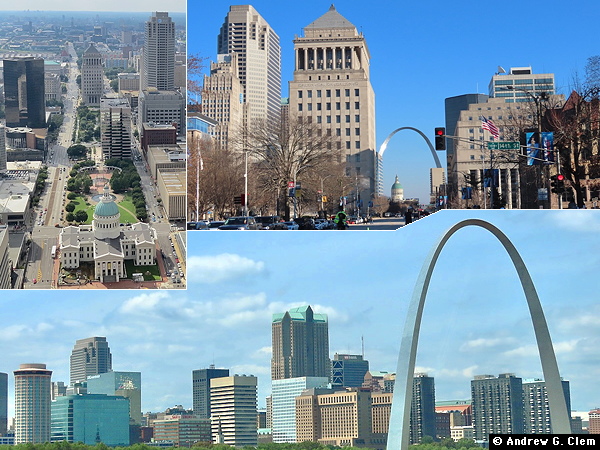
CLOCKWISE FROM TOP LEFT: Three views of downtown St. Louis: from the Gateway Arch (with the Old Court House in front), from the west, and from the south.
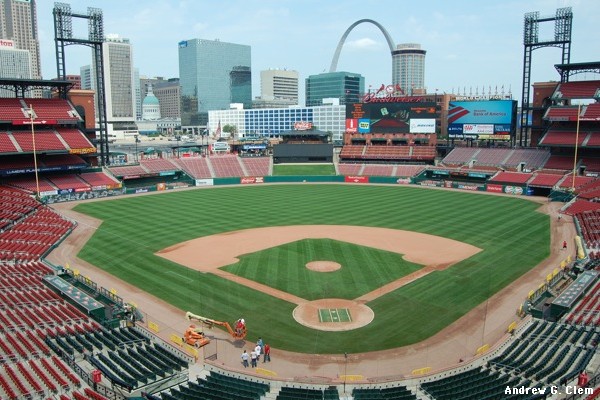
 (Panoramas)
 (Go up.)