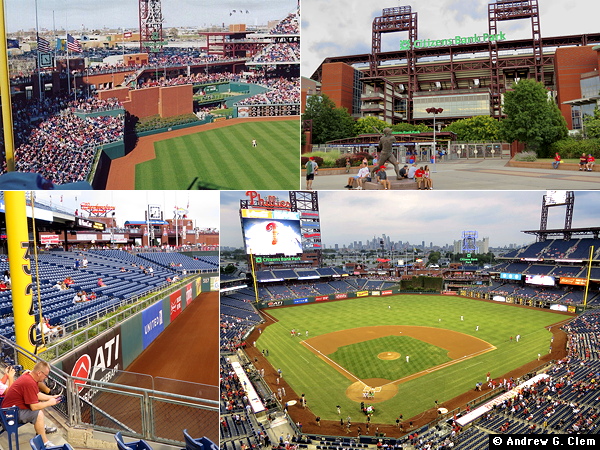
Photos!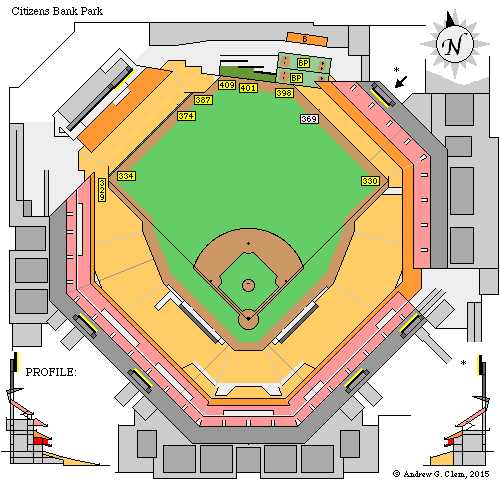
BEEN THERE, DONE THAT: April 4, 2005 (Nationals' inaugural game!) (PHI 8, WSH 4); August 31, 2016 (WSH 2, PHI 1)
ALL-STAR GAME: 2026 WORLD SERIES: 2008, 2009
The wide open spaces are quite a contrast to the Vet! Located just across the street (on the east side) from its huge, intimidating, and mediocre predecessor, Veterans Stadium, Citizens Bank Park represents a quantum leap forward in just about every respect. Only its location in the industrial south end of Philly counts against it. The design is strongly reminiscent of old Shibe Park (Connie Mack Stadium): the first and third base sides of the grandstand are perpendicular to each other, with upper decks extending straight out and the lower deck angling in. Thus, the amount of overhang between the first and second decks dwindles to nil at the corners of the upper decks. Also, the section behind home plate is straight rather than curved. In this respect, it is unique among all the Neoclassical stadiums. The overall shape of the stadium is approximately octagonal, with all grandstand corners angled at 45 degrees. Patron entrances are located at each of the four diagonal sides, attractively framed by the light towers. Form and function match very closely in this ballpark. (The Phillies Web site claimed that their new home's design was also inspired in part by the Baker Bowl, but I am unable to discern any such similarity.)
 Like six of the first seven stadiums in the Neoclassical class, its upper decks extend around a foul pole (in this case, right) about half way toward center field. This was a signature feature of Ebbets Field, and Citizens Bank Park is the only current stadium whose upper deck is not perpendicular at the outer edge. This "wedge" shape is also found at the far end of the upper deck near the left field foul pole, similar to Coors Field, where the "wedge" angle is not so sharp. Like Comerica Park and Great American Ballpark, there is a gap in the upper deck, reflecting the height discontinuity stemming from the extra level of luxury suites in the part of the grandstand closer to the infield. Another similarity to "GABP" is that the upper deck is divided into two parts by a wide walkway that creates a "notch" in the profile. In the above diagram, however, the two levels are color coded as separate sections.
Built of brick and bare steel girders, Citizens Bank Park is very self-conscious about the team's historical roots. In a belated effort to make up for the "wall of shame" erected in Shibe Park's right field during the 1930s to prevent freeloading fans from seeing games from across street, Phillies fans on a budget can watch the game from the roof above the concession building beyond center field. There is plenty of standing room, and attendance at some recent games has exceeded 45,000, more than 1,500 above the nominal seating capacity. The field is visible from the concourse most of the way around the stadium, so you probably won't miss much if you need to get a snack. Three overlapping brick walls serve as the "batter's eye" in center field, and on the reverse side of them is a gallery of images from Philadelphia's baseball history, including the Athletics (who left town in 1955) and the Negro League teams. The Philadelphia skyline is visible beyond center field, about three miles to the north. An electric Liberty Bell symbol atop "Ashburn Alley" behind the center field bullpens provides another element of continuity in the team's identity.
In terms of the playing field, the only significant asymmetry is in center field, where the main wall is angled about six degrees clockwise, so that the corner on the right side of center field is less distant (398 feet, not marked above) than the corner on the left side. In addition, the "bleacher" section juts out several feet from the left field wall; the distance to the left bend (also not marked) is 385 feet. Except in center field, the outfield dimensions closely resemble those of Shibe Park, being fairly cozy, and the same goes for the shape of foul territory and the grandstand itself, full of 45-degree angles. (The outfield dimensions of Veterans Stadium are nearly identical as well, and Philadelphia probably has the most historical consistency in that regard of all major league teams.) The bullpens are situated behind the wedge-shaped extremity of the right-center field lower deck, and partly covered by the second deck. A warm-up pitcher could get hit on the head by a home run without any warning!
Because of the huge number of home runs, the left field wall was moved back slightly prior to the 2006 season, raising the marked distance to the left center field from 369 to 374 feet. (Going by the standard definition of the power alley, the current distance would be about 360 feet.) As a result, the small diagonal portion of the wall in the left field corner was extended into fair territory. The right field wall, where the out-of-town scoreboards are, is still slightly higher than in left field. On January 2, 2012, Citizens Bank Park was the site of the National Hockey League's annual "Winter Classic," as the Philadelphia Flyers hosted the New York Rangers.
SOURCES: Lowry (2006); Pastier (2007); Phillies 2005 official team magazine
FAN TIPS: Scott S.
| The Clem Criteria: | |||||
|---|---|---|---|---|---|
| Field asymmetry |
Archi- tectural design |
Seat proximity |
Location * | Aesthetics | Overall |
| 5 | 9 | 6 | 4 | 8 | 6.4 |

Visit Philadelphia!
The "City of Brotherly Love," Philadelphia served as the political nerve center of the American Revolution, being the site where the Continental Congress signed the Declaration of Independence in 1776, and eleven years later where the U.S. Constitution was drafted. William Penn led the Quaker colonists here, and Ben Franklin later established the free press as a writer and a printer. Since then it has served as the dignified aristocratic heartland of the Eastern Establishment, while New York grabbed all the attention as the commercial and financial center of the burgeoning economic superpower. As such, it is known for its museums and art centers, and of course as the (fictional) home of "Rocky Balboa," the unforgettable character created by Sylvester Stallone.
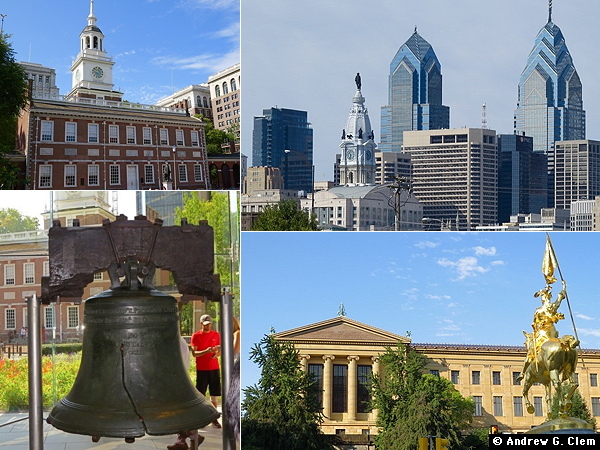
CLOCKWISE FROM TOP LEFT: Independence Hall, downtown Philadelphia skyline with the City Hall in the left foreground; the Philadelphia Museum of Art; and the Liberty Bell.