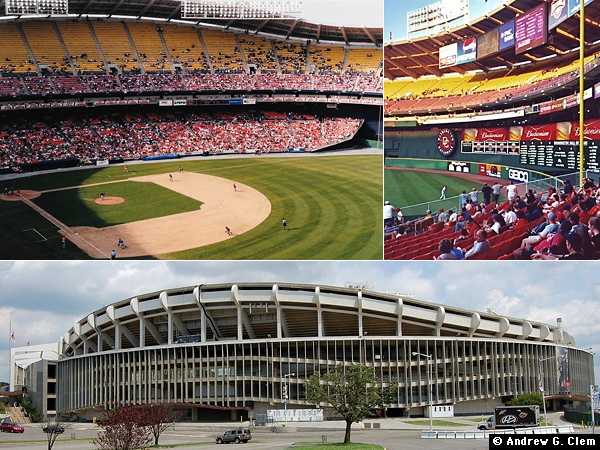
Photos below!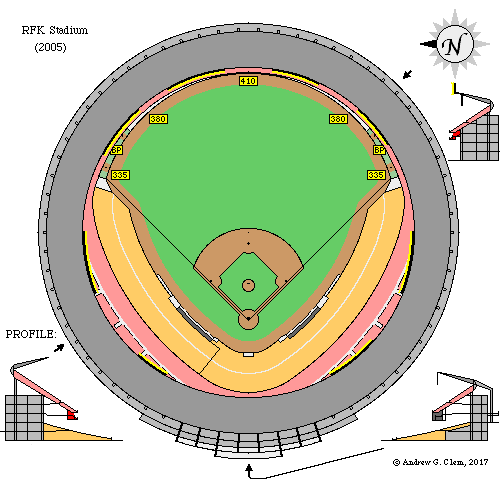
ALSO SEE:
Washington Nationals
team historical records, etc.
ALL-STAR GAMES: 1962, 1969 WORLD CUP SOCCER: 1994
BEEN THERE, DONE THAT: Redskins 24, Lions 7 (1986); Cardinals-Expos exhibition (Apr. 1999); seven Nationals games (2005-2007) ; and a Harvard vs. Georgetown football game (Sept. 30, 2017)
In 1957, the U.S. Congress authorized funding for construction of a new multi-use stadium in Washington, to replace the cramped and aging Griffith Stadium. Construction did not begin until July 1960, however, by which time the owner of the Senators, Calvin Griffith, had already made up his mind to leave town. In 1961 his team moved west and were reborn as the "Minnesota Twins." As a consolation prize, the Nation's Capital received a new baseball franchise, part of the American League expansion that also included the new Los Angeles Angels. Famed military pilot and FAA chief Elwood Quesada became majority owner of the new Senators, who played in Griffith Stadium while the new stadium was hastily built. Only 15 months elapsed between the ground-breaking and the dedication in October 1961, and the Redskins played here before the Senators did.
Originally called "District of Columbia Stadium" (or just "D.C. Stadium"), this was the first of the doughnut-shaped dual-use "cookie-cutter" stadiums that spread like crabgrass across the country during the 1960s and 1970s. RFK is among the smallest stadiums of this genre, which gives it a somewhat cozier feeling that greatly accentuated the noise level of Redskins games during their heyday in the 1970s and 1980s. The fact that the movable section of the lower deck vibrates when you stomp on it greatly increased the already high noise level. One unique and curious aspect of the stadium that is immediately apparent as you drive by is that the roof rises and lowers like a floppy hat. That stems from RFK's unique solution to the fundamental baseball-vs.-football seating conundrum. As a compromise that slightly favored baseball, the front edge of the upper deck sections in foul territory were angled toward the infield, whereas the back sides remained aligned along a perfect circle, as they are in most other such stadiums. As a result, there are about 15 extra rows behind first and third base, at which points the stadium's roof is therefore significantly higher than elsewhere. This variable upper-deck profile was later used in the Kingdome and Tropicana Field Another rather unique aspect of RFK Stadium is the way the baseball-to-football conversion is carried out: The lower deck is swiveled around 80 degrees in a clockwise direction until the left edge stops in straightaway center field. (The only other stadium with that particular kind of reconfiguration scheme was Riverfront Stadium in Cincinnati.) After it was moved, additional seats were then pushed forward to fill the gap behind the western end zone, i.e., behind where third base was. (See diagram.) One consequence of this is that the upper deck hangs out quite close to the northwest corner of the football gridiron, and many fans couldn't see parts of the end zone below.
 Yet another unique aspect of RFK, which reflects its small diameter, is that there are no lower deck seats in the outfield. Indeed, the front edge of upper deck in center field is directly above the fence, providing a good vantage point for watching action in the infield, but you would probably miss a few home runs and/or exciting plays in the outfield. The gap between the fence and the rear wall gradually increases toward the right and left field corners, where the bullpens were. The bullpens were mostly covered by the upper deck, but the one in right field gets more shade, so in 2006 the Nationals switched bullpens, moving from left field to right field. From about 1964 to 1971, both bullpens were located behind the left field fence, apparently necessitating a slight repositioning of the left field fence to provide enough room. While the Senators played at RFK, there was a huge ground-level scoreboard in right field, with a curved top. It was aligned with the end zone of the football gridiron, possibly accounting for the straight section of fence on that side -- a bit of "token" asymmetry. There was a press box for Redskins football games in the top "nosebleed" rows of the upper deck on the first base side. Compared to the other "cookie-cutter" stadiums, RFK Stadium had an above-average fair territory and foul territory.
The upper-deck overhang at RFK is enormous, especially behind home plate and on the first base side, where over 20 rows of the lower deck are in the shadows. It seems to defy the law of gravity! As can be seen in the "lower deck" diagram above, there is a "jog" in the rear edge of the lower deck behind the home team (left side) dugout, with about ten additional rows of seats on the right side. Because of this, the concourse area directly behind home plate is very cramped, hence the structural appendage on the west side, at the grand VIP entrance. Limousines can park within 60-70 feet of the back row of seats, closer than in any other modern MLB ballpark.
Hopes that this modern sports palace would ensure that baseball would remain in the Nation's Capital dwindled as the (new) Senators kept finishing at or near last place. The original owner of the franchise, Elwood Quesada, proved to be inept and in January 1963 he sold the team to a partnership led by James Johnston and Jim Lemon. Not much changed, however. The riots that followed the assassination of Martin Luther King in April 1968 left a tragic stigma on Washington that alienated suburban patrons. It was the assassination of another public figure that year, Sen. Robert F. Kennedy, that led to the renaming of the stadium in January 1969. At about the same time, Bob Short bought the Senators and hired Ted Williams to be the new manager. The Senators finally had a winning season, but fell below .500 the year after that, as attendance plummeted once again. As the ten-year stadium lease was about to expire, Mr. Short demanded better terms than the District of Columbia was willing to offer, and in mid-1971 accepted a can't-lose free-stadium deal from the city of Arlington, Texas. Thus were born the Texas Rangers. In the Senators' final game in September 1971, they had to forfeit because of a riot by angry fans, even though they scored more runs than the Yankees. It was an embarrassing end to a shameful chapter in baseball history.
After the Senators moved to Arlington Stadium in 1972, Our Nation's Capital was devoid of real professional baseball for 33 long years, a monumental travesty. RFK Stadium hosted two Major League Baseball exhibition games in 1972, but fan interest in Washington baseball dwindled away, largely because of "Redskins fever." Each July from 1982 to 1985, there was an "Old-Timers' Classic" sponsored by Cracker Jack at RFK Stadium, but with the stadium in the football configuration, the distance to left field was only about 260 feet! There were one or two exhibition games at RFK each year from 1987 through 1994, but Washington was passed over when the 1993 and 1998 expansions took place. Outrageous! In March 1999, there were two exhibition games between the St. Louis Cardinals and the Montreal Expos, who were rumored to be relocating to D.C. (Six years later, it finally came to pass.) During batting practice, a ball hit by Mark McGwire nicked the edge of the roof in left field!
CINEMA: RFK Stadium was featured in the classic movie Bang the Drum Slowly (1973), though only in a brief scene of a rained-out game, with the tarp being pulled over the diamond. It was also featured in X-Men: Days of Future Past (2014).
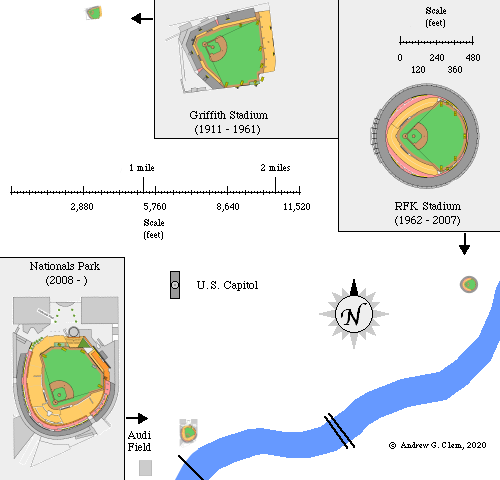
RFK Stadium is located on the east-west axis that cuts through the center of The Mall, as if Pierre L'Enfant himself had planned it that way. This always made for telegenic aerial views from the blimps during Redskins games: RFK, the Capitol, the Washington Monument, and the Lincoln Memorial further beyond. RFK is also close to the Stadium-Armory Metrorail stop and has plenty of parking. It lies between a residential neighborhood full of brick row houses and the Anacostia River. The exterior of the stadium includes several wall sections made of polished dark granite. There is a rough-hewn metallic sculpture of Bobby Kennedy near the west entrance and some attractive landscaping. One of the aesthetic drawbacks of RFK stadium is that the lights were attached to the roof in a haphazard fashion, not in sync with the curved roof line. To maintain a consistent height, the lights were hung below the front edge of the roof where it rises behind first and third bases. During the Senators era, the 40-foot wall beyond left field was bare, with no decorations, and the chain link fence further undermined the visual appeal. In the 1970s, a new main scoreboard was installed beyond the eastern end zone (right center field), likewise suspended below the roof, along with some advertising billboards. The front edge of the mezzanine level used to feature the names of past Washington sports heroes. This "Ring of Fame" included Walter Johnson, Roy Sievers, Harmon Killebrew, Frank Howard, Sammy Baugh, Sonny Jurgensen, Joe Thiesman, Wes Unseld, and Sugar Ray Leonard. When the Nationals (ex-Expos) moved there from Olympic Stadium in 2005, a video "ribbon" was installed in front of the mezzanine, and a huge banner bearing those names was posted on the wall in back of the bullpen in right field.
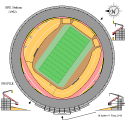 Of course, nearly everyone associates RFK Stadium with the Washington Redskins, who played there from 1961 until 1996. After the Senators left town, it became a football-only stadium, with semi-permanent bleachers built on the east side. (That is the period depicted in the diagram above, which does not correspond to the 1960s-era baseball configuration.) Since 1997, the Redskins have played at Jack Kent Cooke Stadium, a.k.a. Redskins Field, a.k.a. FedEx Field, located in beautiful downtown Landover, Maryland.
When Major League Soccer was founded in 1996, the D.C. United team began playing in RFK Stadium. Since then, the team has won a total of four Major League Soccer championships: 1996, 1997, 1999, and 2004. There have been some international soccer matches there as well, including five matches in the 1994 World Cup. Because attendance at soccer games seldom exceeds 20,000, the upper deck is normally closed. When baseball returned to RFK in 2005 (see below), special arrangements had to be made to allow for sharing the field: the pitcher's mound was built on a retractable platform that was lowered during soccer games, and grass sod was planted in the infield. The results of this awkward accommodation were mixed. Also, the retractable seats that used to line the western end zone for Redskins games are no longer used, leaving a huge gap. For many years, D.C. United pushed to get help in building a new soccer stadium, complaining that RFK is poorly maintained. The team finally reached terms with the D.C. government, and located two blocks southwest of Nationals Park. (Construction delays forced the team to find an alternate home field for the early months of the 2018 season. In mid-2018, they finally moved into their new home, Audi Field, leaving RFK Stadium essentially abandoned. After repeated delays due mainly to prolonged negotiations over where to build a new stadium for the Washington "Commanders," demolition of RFK Stadium was completed by the end of 2025. Under current plans, the new football stadium will be built on this same site by 2030 or so.
RFK Stadium also hosted a large number of rock concerts over the years, most notably including the Beatles, on August 15, 1966.
After years of rumors about getting a baseball team, D.C. Mayor Anthony Williams announced on September 29, 2004 that the Montreal Expos would move to Washington. MLB Commissioner Bud Selig confirmed it the next day. After some hair-raising turns of events on the D.C. Council over the next few months, the required legislation to finance the new stadium was finally passed, thereby ensuring that the relocation would indeed take place. The "born again" Washington Nationals surprised everyone in their inaugural season, climbing to first place in June and holding that position for over six weeks. In late July 2005 it was discovered that the correct distance to 380-foot distance markers was actually about 395 feet, so the markers were moved about 40 feet toward the respective foul poles. For some unknown reason, the capacity rose from 45,250 to 46,382 in 2006. In the final baseball game ever played at RFK Stadium, September 23, 2007, the Nationals came from behind to beat the Phillies, 5-3. (Ironically, Jayson Werth -- who joined the Nationals in 2011 -- struck out to end that game!) It was a better way to say "goodbye" than when the Senators ended their stay in Washington in 1971. For those three years, the Nationals had an overall record of 122-121 at RFK Stadium. In March 2008 they moved into their new home at Nationals Park, and the rest is history.
Occasional college football games (such as those of Georgetown University) were held at RFK Stadium over the years. In December 2008, the inaugural Eagle Bank Bowl was held there, continuing there for five years (becoming the "Military Bowl" in 2010) until 2013, when it moved to Navy-Marine Corps Stadium in Annapolis. The seating configuration for post-2004 football games remained the same as for D.C. United soccer games, however, with a large void beyond the western goal.
SOURCES: Lowry (2006); Pastier (2007); USA Today / Fodor's (1996); Washington Post; James R. Hartley, Baseball At RFK Stadium (2008)
FAN TIPS: Vincent Paterno, Rudi Riet, Drew Saikin
WEB LINK: phanfare.com
| The Clem Criteria: | |||||
|---|---|---|---|---|---|
| Field asymmetry |
Architectural design |
Seat proximity |
Location * | Aesthetics | Overall |
| 1 | 6 | 5 | 5 | 5 | 4.4 |
* See the Stadium locations page.